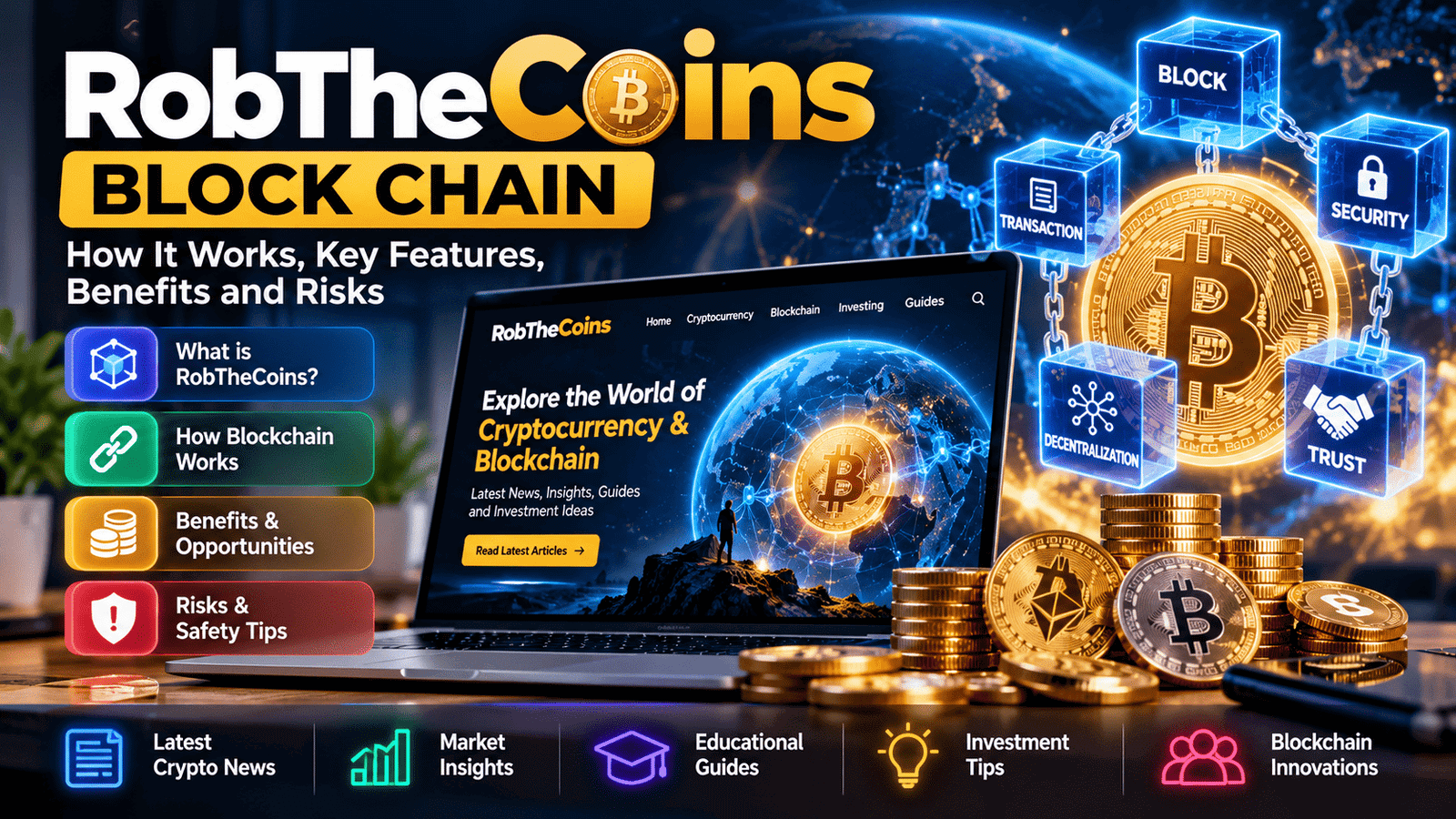
Blockchain technology is changing how people think about digital transactions, cryptocurrency, online security, and financial innovation. As interest in decentralized systems continues to grow, many users search for information about emerging blockchain-related names and platforms. One such search term is RobTheCoins block chain.
If you are researching RobTheCoins, you may want to understand its connection with blockchain technology, the potential applications of distributed ledgers, and the risks associated with cryptocurrency-related services.
RobTheCoins.com publishes content about cryptocurrency, blockchain innovation, investing, and digital business. However, it is important to distinguish between a website that publishes blockchain information and a verified blockchain network or cryptocurrency project. The available public information does not establish that RobTheCoins operates its own independent blockchain.
In this guide, we will explain the meaning of RobTheCoins block chain, how blockchain technology works, its potential applications, and the essential checks you should perform before trusting any blockchain-related project.
What Is RobTheCoins Block Chain?
The keyword RobTheCoins block chain connects the RobTheCoins name with blockchain technology and cryptocurrency-related information.
People searching for this term may be interested in learning about decentralized finance, digital assets, transaction security, smart contracts, or the potential role of blockchain in modern businesses.
The official RobTheCoins website describes itself as a resource for understanding cryptocurrency, blockchain innovation, and investing. Its content includes educational articles and practical guides covering digital finance and related technologies.
However, the term should not automatically be interpreted as the name of a separate blockchain network.
A genuine blockchain project generally provides verifiable technical information, such as its network architecture, consensus mechanism, transaction records, developer documentation, and other details that can be independently checked.
Before treating RobTheCoins as a blockchain protocol, token, or investment platform, readers should verify whether those specific products exist and whether their claims are supported by reliable evidence.
What Is Blockchain Technology?
Blockchain is a type of distributed ledger technology that records transactions or other information in a structured sequence of blocks.
Depending on the network, participants use cryptographic techniques and a consensus mechanism to validate transactions and maintain an agreed record.
Unlike a conventional database controlled by one organization, a public blockchain can allow multiple independent participants to maintain and verify the ledger according to shared rules.
Important components of blockchain technology include:
- Distributed ledger: A record of transactions maintained across participating computers or nodes.
- Cryptography: Techniques used to protect data integrity and authenticate certain actions.
- Consensus mechanism: A process that helps network participants agree on valid transactions or the state of the ledger.
- Blocks: Groups of records linked together according to the blockchain’s protocol.
- Smart contracts: Programs that execute predefined rules on supported blockchain networks.
- Wallets: Tools that help users manage cryptographic keys and interact with digital assets.
These components work differently across blockchain networks. Not every blockchain supports the same transaction model, smart-contract functionality, or level of decentralization.
How Does Blockchain Work?
Understanding the basic process can help readers evaluate blockchain-related claims more effectively.
1. A Transaction Is Initiated
A user begins an action, such as transferring a digital asset to another wallet or interacting with a decentralized application.
The transaction typically contains information required by the relevant blockchain protocol.
2. The Network Receives the Transaction
The transaction is broadcast to participating network infrastructure. Depending on the blockchain, nodes check whether it follows the protocol’s rules.
For a cryptocurrency transfer, these checks may include verifying the sender’s authorization and confirming that the transaction meets the network’s requirements.
3. Transactions Are Validated
The network uses its particular validation and consensus rules to determine which transactions can be accepted.
Proof of Work and Proof of Stake are two widely known consensus approaches, although many other designs exist.
4. Records Are Added to the Ledger
Accepted transactions are included in blocks or otherwise recorded according to the network’s design.
Cryptographic links between blocks help make unauthorized changes detectable. However, blockchain security still depends on the protocol, implementation, network participants, and surrounding systems.
5. The Transaction Receives Confirmation
Once a transaction is recorded, it may receive additional confirmations as the network progresses.
The meaning of confirmation and the degree of finality vary across networks. Users should check the specific blockchain’s rules before assuming that a transaction cannot be reversed or reorganized.
This process helps explain blockchain technology generally. It does not confirm that RobTheCoins operates a blockchain using any particular architecture.
Key Features of Blockchain Technology
Blockchain systems can offer several useful capabilities, depending on their design and intended application.
Transparency and Verifiability
Public blockchains allow users to inspect many transaction records through blockchain explorers.
This transparency can help researchers verify transfers, monitor addresses, and investigate certain types of activity.
However, a public transaction record does not automatically reveal the real-world identity of the people involved. Nor does it prove that a project is trustworthy.
Decentralized Recordkeeping
Some blockchain networks distribute recordkeeping among independent participants rather than relying on a single administrator.
This can reduce dependence on one organization, although the actual degree of decentralization varies between networks.
A project that uses blockchain terminology is not necessarily decentralized. Its governance, infrastructure, and administrative permissions must be examined separately.
Smart Contract Automation
Smart contracts can execute programmed actions when specified conditions are met.
They are used in applications such as decentralized exchanges, token transfers, digital collectibles, and certain financial protocols.
Smart contracts can also contain bugs or exploitable permissions. Their presence alone does not establish that an application is secure.
Traceable Transactions
Blockchain explorers allow users to examine transactions and follow the movement of assets between addresses.
This can be useful when verifying whether a claimed transaction occurred on a particular network.
Users should confirm the network, token contract address, and transaction details instead of relying solely on screenshots or promotional claims.
Digital Asset Transfers
Supported blockchain networks can enable digital assets to move between compatible wallets without using the same transaction infrastructure as conventional bank transfers.
Nevertheless, transfers can involve network fees, delays, exchange-rate changes, and irreversible mistakes.
Always verify the destination address and network before sending cryptocurrency.
Potential Benefits of Blockchain for Businesses
Blockchain technology can be useful in specific business situations, but it is not the best solution for every problem.
Improved Shared Recordkeeping
Organizations that need to coordinate records across multiple parties may benefit from a shared ledger, particularly when participants do not want one organization to control the entire record.
The value depends on the business process and whether a conventional database would be simpler.
Automated Business Processes
Smart contracts can automate certain actions, such as releasing digital assets when programmed conditions are satisfied.
This may reduce some manual steps, but automation does not eliminate the need for legal agreements, monitoring, or dispute resolution.
Digital Ownership and Tokenization
Some blockchain applications represent assets or rights through digital tokens.
The legal meaning of a token depends on the applicable terms, laws, and underlying arrangements. Holding a token does not automatically establish ownership of a physical asset or guarantee a financial return.
International Transactions
Certain blockchain networks support cross-border digital asset transfers.
Potential benefits must be considered alongside transaction costs, liquidity, regulatory requirements, conversion fees, and price volatility.
For businesses evaluating a blockchain solution, the most important question is whether it solves a genuine operational problem better than available alternatives.
RobTheCoins Block Chain and Cryptocurrency: What Should You Know?
Blockchain and cryptocurrency are related, but they are not interchangeable terms.
A blockchain is the underlying technology or ledger system. A cryptocurrency is a digital asset that may operate on a blockchain or another type of distributed network.
When researching RobTheCoins block chain, it is important to establish exactly what the name refers to.
Consider these questions before relying on any associated claims:
Does a dedicated network exist? Look for technical documentation identifying the blockchain, its architecture, and its intended use.
Is there a verifiable token? If a project claims to have a cryptocurrency, verify its exact name, contract address where applicable, blockchain network, and independently accessible transaction records.
Is the technology documented? Look for developer resources, technical specifications, and a clear explanation of how the system works.
Can independent sources verify the claims? Search for credible technical analysis rather than relying exclusively on promotional articles.
Are financial claims realistic? Promises of guaranteed returns or risk-free earnings should be treated with considerable caution.
Until these questions can be answered with reliable evidence, avoid assuming that RobTheCoins is a proprietary blockchain, cryptocurrency, or service that manages users’ digital assets.
Is RobTheCoins Block Chain Legit or Safe?
It is not possible to determine the legitimacy of a blockchain project from its name alone.
RobTheCoins.com presents itself as an informational website, but that does not independently verify the existence or safety of any separate blockchain product associated with the name.
If you encounter a service claiming to operate the RobTheCoins blockchain, assess the specific service rather than relying on the reputation of a similarly named website.
Use the following checklist.
Verify the Official Domain
Check the exact domain name and make sure you are not visiting a copycat website using a similar spelling.
Review Technical Documentation
A legitimate blockchain project should provide enough information to explain its technical design and how users can verify its operations.
Check Blockchain Explorer Records
If a project claims to process transactions on a public blockchain, ask for verifiable transaction hashes and relevant network details.
Remember that genuine blockchain transactions do not prove that the organization promoting them is honest.
Investigate the Team and Organization
Look for credible information about the people or organization operating the service, its business model, and its responsibilities.
Claims of professional experience or regulatory status should be independently verified.
Understand the Financial Risks
Cryptocurrency prices can fluctuate significantly. Users can lose money because of market movements, fraud, technical failures, or mistakes involving private keys.
Never invest money you cannot afford to lose, and do not share your recovery phrase or private keys with anyone claiming to provide support.
Common Blockchain Risks to Understand
Even well-established blockchain technologies have limitations. Understanding them is essential before using any crypto-related service.
Smart Contract Vulnerabilities
Programming errors or poorly designed permissions can expose digital assets to theft or unauthorized activity.
Independent security audits can provide useful information, but an audit is not a guarantee that a contract is safe.
Phishing and Fake Websites
Fraudulent websites may imitate legitimate brands to collect wallet credentials or trick users into approving malicious transactions.
Always verify URLs and use trusted sources to locate official applications.
Irreversible Transactions
Many blockchain transactions cannot be reversed through a central administrator once they reach the required level of finality.
Double-check recipient addresses, networks, and transaction amounts before confirming a transfer.
Market Volatility
Digital assets may experience rapid price changes. A project’s technical functionality does not guarantee that its token, if one exists, will retain value.
Regulatory Uncertainty
Cryptocurrency rules vary by country and can change over time. Users should understand the requirements that apply to their location and the particular service they intend to use.
How to Research Blockchain Projects More Effectively
If you want to learn more about RobTheCoins or any other blockchain-related name, follow a structured research process.
- Start with the official website. Read the About page, available product information, and published terms.
- Identify the actual product. Determine whether you are researching an educational blog, a blockchain network, a token, a wallet, or an exchange.
- Find primary technical sources. Look for official documentation, developer repositories, network explorers, and verifiable transaction information where applicable.
- Check independent evidence. Compare the claims with credible security researchers, established technical publications, and relevant official records.
- Review the risks. Understand the fees, administrative permissions, security limitations, and financial exposure involved.
- Avoid rushed decisions. Do not deposit funds or connect a wallet because of countdown timers, pressure from promoters, or promises of guaranteed profits.
This approach helps separate established facts from assumptions and unsupported marketing language.
Read More: About Blog WizzyDigital.org | Pinoroduct Com | PlayMyWorld Latest Gaming
Frequently Asked Questions About RobTheCoins Block Chain
1. What is RobTheCoins block chain?
RobTheCoins block chain is a search phrase connecting the RobTheCoins name with blockchain technology and cryptocurrency-related topics. It does not, by itself, establish that a separate blockchain network exists under that name.
2. Is RobTheCoins a blockchain network?
The available public information does not sufficiently verify that RobTheCoins operates an independent blockchain network. Its official website primarily presents cryptocurrency, blockchain, and investing content.
3. Is RobTheCoins associated with cryptocurrency?
Yes, the RobTheCoins.com website publishes cryptocurrency-related content. However, publishing cryptocurrency information is different from operating a cryptocurrency exchange, wallet, token, or blockchain network.
4. How does blockchain technology work?
Blockchain technology records information in a structured ledger. Participating nodes validate transactions according to the network’s rules, and accepted records are added through the network’s particular consensus or validation process.
5. Can blockchain technology improve business security?
Blockchain can provide tamper-evident records and verifiable transactions in appropriate use cases. However, it cannot eliminate all security risks, including compromised accounts, faulty smart contracts, phishing, or poor operational practices.
6. Is RobTheCoins safe for cryptocurrency investments?
The name alone does not establish whether a particular investment or service is safe. Verify the actual product, its operators, technical evidence, applicable regulations, and financial risks before making any commitment.
7. How can I verify a blockchain transaction?
Identify the correct network and locate the transaction using its transaction hash in a reputable blockchain explorer. Check the status, addresses, amount, and confirmation details.
8. Does blockchain guarantee profits?
No. Blockchain is a technology, not a guarantee of investment performance. Cryptocurrency values can decline, projects can fail, and users can lose their funds.
Conclusion
The keyword RobTheCoins block chain reflects interest in the relationship between the RobTheCoins name and blockchain technology.
Blockchain can support transparent recordkeeping, digital asset transfers, and automated processes, but its benefits depend on the underlying network and the problem being solved.
RobTheCoins.com publishes educational material about cryptocurrency, blockchain innovation, and investing. However, readers should not assume that the website operates a separate blockchain or offers a verified cryptocurrency simply because these topics appear in its content.
Before trusting any related product, verify its technical documentation, transaction records, operators, and financial claims. Protect your private keys, be cautious of guaranteed-return promises, and rely on independent evidence rather than promotional language.
The most effective way to approach blockchain is to understand the technology, investigate the specific project, and evaluate the risks before making decisions involving money or digital assets.