
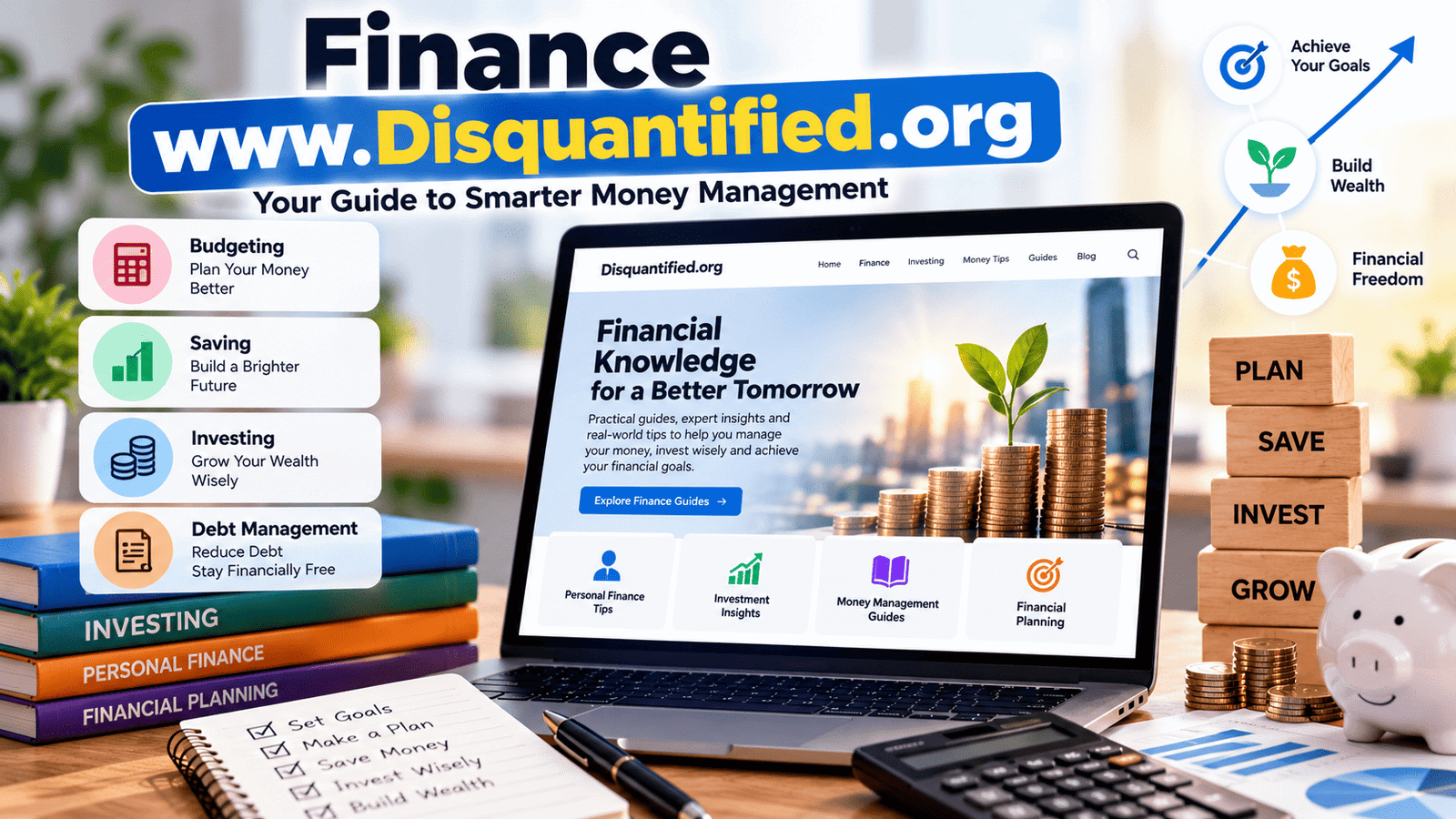
Managing money effectively is an important life skill, whether you want to save for the future, reduce debt, understand investing, or build better spending habits. However, financial information can sometimes feel complicated, especially for beginners who are unfamiliar with banking, budgeting, and investment terminology. This is where online financial education resources can help.
The search term finance www disquantified .org is associated with people looking for financial information and money management resources on Disquantified.org. The website publishes articles covering personal finance, budgeting, saving, debt management, and investing concepts.
For readers who want to improve their financial knowledge, exploring educational articles can be a useful starting point. However, understanding financial concepts is different from receiving personalized financial advice. Important decisions involving loans, taxes, investments, or retirement planning require careful research and consideration of individual circumstances.
In this guide, we will explore what finance www Disquantified .org means, the types of financial topics readers can discover, practical money management strategies, and ways to evaluate financial information before applying it to real-life decisions.
What Is Finance www Disquantified .org?
The phrase finance www disquantified .org generally refers to financial content associated with the website Disquantified.org.
The website publishes educational material about money management and financial topics. Its content can help readers explore subjects such as budgeting, saving, managing debt, understanding investments, and developing better financial habits.
Rather than treating finance as a subject reserved for professionals, beginner-friendly financial education aims to explain important concepts in accessible language.
Readers exploring Disquantified.org may be interested in learning about:
- Personal budgeting and expense management.
- Saving money and building emergency funds.
- Debt management and borrowing decisions.
- Basic investing principles.
- Financial planning and long-term goals.
- Understanding financial terminology.
- Evaluating online financial information.
The usefulness of any particular article depends on its accuracy, supporting evidence, and relevance to the reader’s situation.
It is also important to distinguish Disquantified.org from similarly named websites. Always check the complete domain address before relying on information or entering personal details.
Read More: About Blog WizzyDigital.org
What Financial Topics Can You Explore on Disquantified.org?
Financial education covers several interconnected subjects. Understanding how these areas work together can help people develop a more organized approach to managing money.
1. Personal Finance and Budgeting
Personal finance involves managing income, expenses, savings, borrowing, and financial goals.
A budget helps you understand where your money goes and how much remains after essential expenses.
For example, someone who receives a monthly income can divide spending into categories such as housing, food, transportation, utilities, savings, and entertainment.
A practical budgeting process includes:
- Calculate your monthly take-home income.
- List essential and discretionary expenses.
- Identify unnecessary or irregular spending.
- Set realistic savings targets.
- Review your budget regularly.
The purpose is not to eliminate every enjoyable expense. It is to ensure that spending decisions support your priorities.
2. Saving Money and Building Financial Security
Saving provides financial flexibility when unexpected expenses arise or future goals require additional funds.
An emergency fund can help cover costs such as medical bills, urgent repairs, temporary income loss, or other unexpected obligations.
The appropriate amount depends on your income stability, essential expenses, dependents, and access to other financial resources.
A practical starting point is to calculate one month’s essential expenses and gradually build savings from there.
Automating a small transfer into a separate savings account can make the habit easier to maintain.
Readers researching finance www disquantified .org may find saving-related articles useful for understanding how consistent habits contribute to financial stability.
3. Debt Management and Borrowing
Debt can help people meet certain financial needs, but borrowing also creates repayment obligations and potential financial pressure.
Understanding interest rates, repayment schedules, processing fees, penalties, and the total borrowing cost is essential before accepting a loan.
For example, a loan with a seemingly low monthly payment may still be expensive if the repayment period is long or additional fees apply.
To manage existing debt more effectively:
- List all outstanding balances.
- Record interest rates and minimum payments.
- Pay at least the required amount on time.
- Consider prioritizing high-interest debt.
- Avoid taking new loans without understanding the repayment impact.
If you are struggling with repayments, contact your lender to discuss legitimate options before missing payments.
4. Investing and Understanding Financial Markets
Investing involves committing money to assets with the expectation of potential future returns. However, returns are uncertain, and losses are possible.
Beginners should understand several fundamental concepts before choosing investments.
Risk and return: Investments with greater potential returns may involve greater uncertainty or loss.
Diversification: Spreading investments across different assets can reduce the impact of some individual risks, although it cannot eliminate market risk.
Time horizon: The length of time you expect to keep money invested can influence which investment approaches are appropriate.
Costs and fees: Management charges, transaction fees, and taxes can affect the amount you ultimately receive.
Liquidity: Some assets are easier to sell quickly than others, and the sale price may differ from expectations.
Financial education can help readers understand these concepts, but an educational article cannot guarantee returns or determine the best investment for every individual.
Before investing, consider your financial goals, emergency savings, outstanding debt, risk tolerance, and applicable regulations.
5. Financial Planning for Long-Term Goals
Financial planning connects everyday money decisions with future objectives.
These objectives may include buying a home, funding education, starting a business, preparing for retirement, or building a financial safety net.
A useful plan identifies the goal, estimates the required amount, establishes a timeline, and determines how much can realistically be set aside.
Reviewing the plan periodically helps you adjust to changes in income, expenses, and personal priorities.
Long-term financial progress usually depends more on consistent habits and informed decisions than on finding a single perfect financial strategy.
Read Also: Pinoroduct Com
How to Use Finance www Disquantified .org Effectively
Online financial resources are most useful when readers apply a structured approach to learning.
Step 1: Identify Your Financial Question
Begin with a specific question rather than trying to understand every financial topic at once.
For example, you might want to learn how to create a budget, compare loan costs, build emergency savings, or understand the difference between stocks and bonds.
Step 2: Find Relevant Articles
Explore the finance-related categories and search for articles that directly address your question.
Review the headings, explanations, examples, and any references provided by the author.
Step 3: Check the Information’s Accuracy
Financial information can become outdated when interest rates, tax rules, regulations, or financial products change.
Check the publication date and verify important details through official sources, such as government departments, regulators, financial institutions, or relevant product documentation.
Step 4: Apply the Information to Your Situation
Use educational guidance to improve your understanding, then consider your own income, expenses, obligations, and goals.
A budgeting method that works for one household may not work equally well for another.
Step 5: Review Your Progress
Track whether your financial habits are improving.
You might measure monthly savings, changes in debt balances, spending against your budget, or progress toward a specific financial goal.
Regular reviews help you identify what is working and what needs adjustment.
Is Finance www Disquantified .org Reliable?
The reliability of financial information depends on the quality of the individual article and the evidence supporting its claims.
Disquantified.org presents financial content for readers interested in money management and investing concepts. However, the presence of an article on a website does not automatically make its recommendations suitable for every reader.
Before relying on financial information, consider the following checks.
Author transparency: Does the article identify its author and relevant qualifications?
Source quality: Are important facts supported by official documents, reliable research, or credible references?
Publication date: Is the information current enough for the topic?
Clear limitations: Does the article explain financial risks and acknowledge uncertainty?
Conflicts of interest: Is the content promotional, sponsored, or connected to a product being recommended?
Independent verification: Can important claims be confirmed through a trusted source outside the website?
These checks are particularly important when information involves investments, loans, insurance, taxes, or promises of unusually high returns.
Treat online articles as educational resources rather than substitutes for individualized professional guidance.
Read Also: RobTheCoins Block Chain
Practical Money Management Tips for Beginners
Learning financial concepts is valuable, but consistent action is what turns knowledge into better habits.
Here are several practical steps you can start using today.
Track Your Spending
Record your expenses for a month. This can reveal recurring costs and spending patterns that are easy to overlook.
Set a Realistic Savings Goal
Choose an amount you can save consistently without neglecting essential expenses.
A small, sustainable contribution can be more useful than an ambitious target that quickly becomes difficult to maintain.
Reduce Unnecessary Fees
Review bank charges, subscriptions, late-payment penalties, and other recurring costs.
Cancel services you no longer need and compare alternatives carefully.
Pay Attention to High-Interest Debt
Understand which debts cost the most and create a repayment plan that fits your budget.
Avoid sacrificing essential expenses or exhausting all emergency savings simply to make an aggressive repayment.
Learn Before Investing
Understand the product, potential losses, fees, liquidity, and relevant regulations before committing money.
Be especially cautious of anyone promising guaranteed profits from investments that involve market risk.
Review Your Financial Progress
Schedule a monthly review to assess spending, savings, debt, and progress toward your goals.
Small adjustments made consistently can improve your financial organization over time.
Read Also: PlayMyWorld Latest Gaming
Common Financial Mistakes to Avoid
Financial education can also help readers recognize habits that may undermine their goals.
- Spending more than their income can sustainably support.
- Ignoring high-interest debt and repayment deadlines.
- Investing emergency savings in volatile assets.
- Making investment decisions based on social media hype.
- Failing to account for fees and taxes.
- Trusting guaranteed-return claims without verification.
- Sharing banking credentials or sensitive information with unverified services.
- Following financial advice without considering personal circumstances.
Avoiding these mistakes does not guarantee financial success, but it can help reduce preventable risks.
Frequently Asked Questions About Finance www Disquantified .org
1. What is finance www disquantified .org?
Finance www disquantified .org is a search phrase associated with the financial education content available on Disquantified.org. The website publishes articles about budgeting, saving, debt management, investing, and related money topics.
2. What can I learn from Disquantified.org finance articles?
Depending on the article, readers can explore personal finance basics, budgeting methods, saving strategies, debt management, investment terminology, and financial planning concepts.
3. Is Disquantified.org suitable for financial beginners?
Its educational content may be useful for beginners who want to understand financial concepts in accessible language. Readers should still verify important facts and determine whether a recommendation applies to their circumstances.
4. Can I use Disquantified.org to make investment decisions?
You can use educational articles to understand investment concepts, but you should not rely on one website alone for important financial decisions. Verify claims through credible sources and consider qualified professional advice when appropriate.
5. Does Disquantified.org guarantee investment returns?
Educational information does not guarantee investment returns. Any claim of guaranteed profits should be examined carefully, especially when the investment involves market risk.
6. How can I improve my financial knowledge?
Start with budgeting, emergency savings, debt management, and basic investment principles. Learn one topic at a time, use reliable sources, and apply what you learn to measurable financial goals.
7. How can I verify financial information found online?
Check the author’s qualifications, publication date, references, and potential conflicts of interest. Verify rules and figures through official government, regulatory, or financial institution sources.
Conclusion
The search term finance www disquantified .org reflects an interest in finding financial education and money management information through Disquantified.org.
The website’s finance-related content can serve as a starting point for understanding budgeting, saving, borrowing, investing, and long-term financial planning. These subjects are useful for people who want to make more informed decisions about their money.
However, reading financial content is only the first step. Verify important claims, consider your personal circumstances, understand the risks, and avoid making major financial decisions based on unsupported promises.
By combining reliable educational resources with consistent budgeting, thoughtful saving, responsible borrowing, and careful investment research, readers can build stronger financial habits and work toward their long-term goals.