

If you are thinking about a career in medical imaging one of the more critical steps you can take is to understand the ultrasound tech salary landscape. Ultrasound X-ray technicians also known as diagnostic medical sonographers use high-frequency sound waves to create images of organs, tissues and blood flow within the human body. These images assist physicians in both diagnosing and monitoring a multitude of diseases.
Over the past 10 years, the ultrasound tech salary has increased considerably and has made this profession among the most lucrative careers in allied health. Sonographers are employed in hospitals, clinics, private imaging centers, and physician offices. They do non-invasive, high-level skilled work that is vital to modern medicine, which is why employers pay lucrative wages.
This ultimate ultrasound tech salary guide walks you through a multitude of details about salary from national averages and state-by-state breakdowns to specialty pay, experience level differences, top-paying employers and career growth projections. Whether you are a student, a working sonographer, or considering a career change, this guide has everything you need to know to understand what you can expect to earn.
National Average Ultrasound Tech Salary
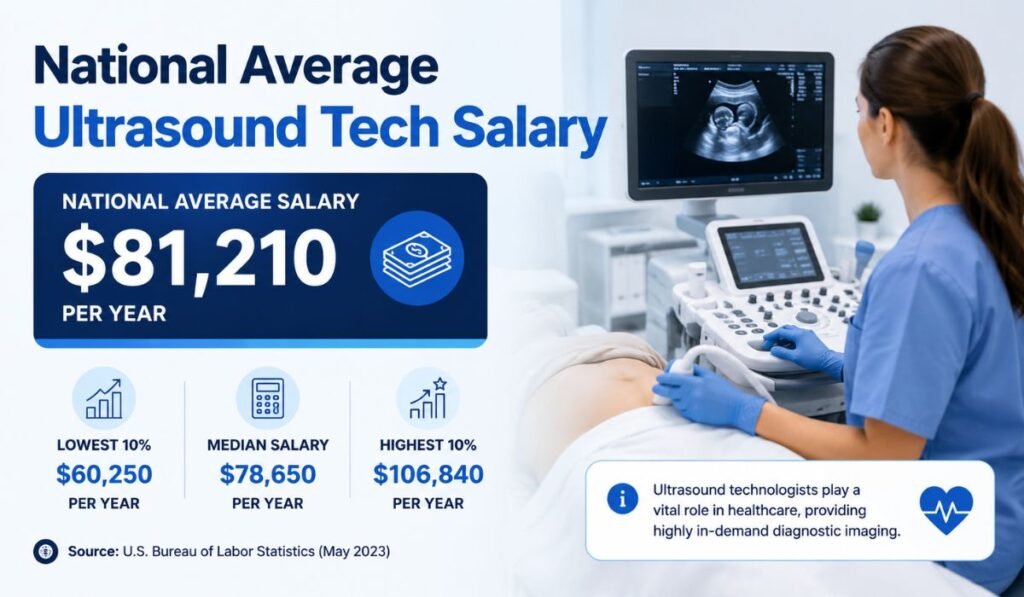
As reported by the U.S. Bureau of Labor Statistics (BLS) and recent industry surveys, the average salary of ultrasound techs in America remains safely in the mid-to-upper range of health professions.
| Pay Metric | Annual Salary | Hourly Rate |
| Entry-Level (0–2 yrs) | $52,000 – $62,000 | $25 – $30 |
| Mid-Level (3–6 yrs) | $65,000 – $78,000 | $31 – $37 |
| Experienced (7–14 yrs) | $80,000 – $95,000 | $38 – $46 |
| Senior/Lead (15+ yrs) | $97,000 – $115,000 | $47 – $55 |
| National Median (All) | $77,740 | $37.38 |
These figures represent full-time employment with traditional benefits. And when overtime, shift differentials and bonuses are added in, the ultrasound tech salary can be much greater than the numbers shown here. A large number of sonographers at a high-demand hospital take home a total annual salary of over $90,000.
Read Also:- 14 LPA In Hand Salary
Ultrasound Tech Salary by State
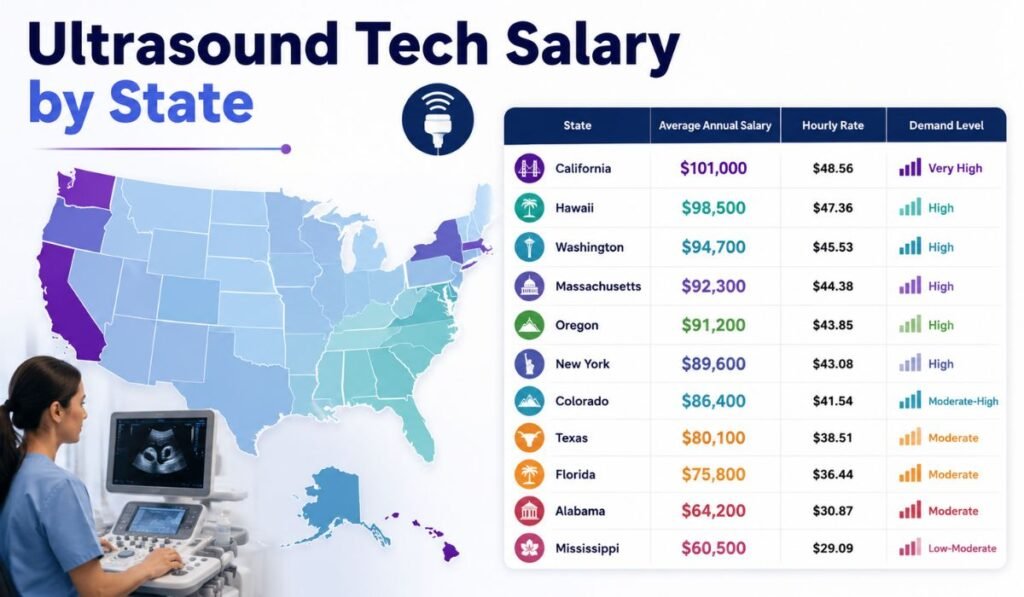
Of all the factors, geography is perhaps the highest determinant of ultrasound tech salary. Higher cost of living states and large metropolitan areas are generally associated with higher salary. Here is a list of the highest-paying and average-paying states for ultrasound technicians.
| State | Average Annual Salary | Hourly Rate | Demand Level |
| California | $101,000 | $48.56 | Very High |
| Hawaii | $98,500 | $47.36 | High |
| Washington | $94,700 | $45.53 | High |
| Massachusetts | $92,300 | $44.38 | High |
| Oregon | $91,200 | $43.85 | High |
| New York | $89,600 | $43.08 | High |
| Colorado | $86,400 | $41.54 | Moderate-High |
| Texas | $80,100 | $38.51 | Moderate |
| Florida | $75,800 | $36.44 | Moderate |
| Alabama | $64,200 | $30.87 | Moderate |
| Mississippi | $60,500 | $29.09 | Low-Moderate |
These numbers have floated California as a perennial list topper for ultrasound tech salary, matched or exceeded only by the extreme demand for the profession, both due to the complex, large healthcare system and well-established labor protections. But with a much higher cost of living than the national average in California, salary comparisons across states must factor in how far that money goes.
Read Also:- 18 LPA In Hand Salary
Ultrasound Tech Salary by Specialty
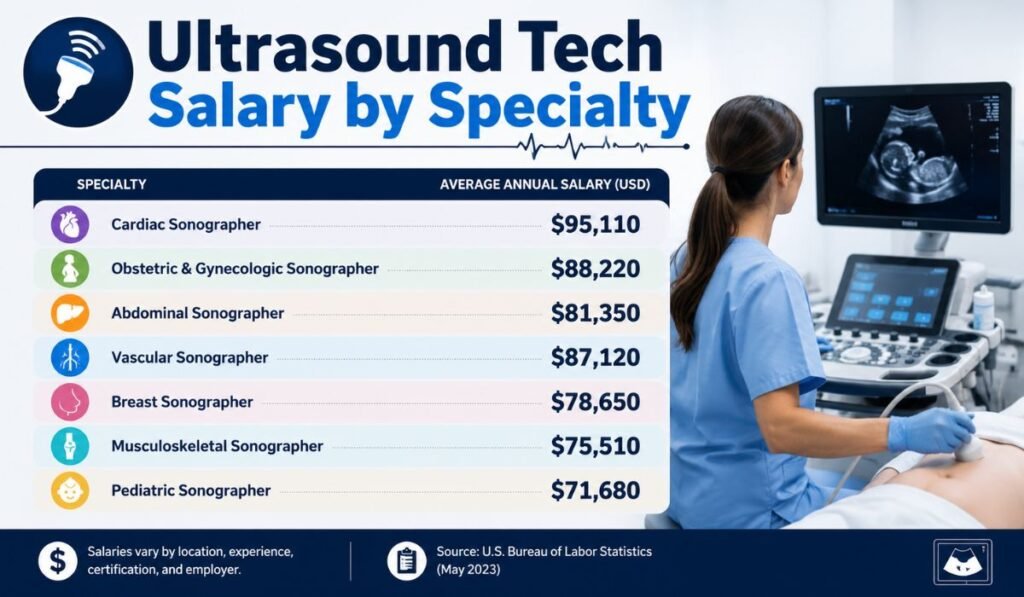
Unfortunately, the average sonographer salary is not the same everywhere. Your ultrasound tech salary will be dramatically influenced by the specialty area that you choose. Certain specialties, for which you can earn added certifications, are priced higher. Here is an overview of the top most common and top 3 ultrasound specialty types with the highest salaries.
| Specialty | Average Annual Salary | Certification Required |
| Cardiac Sonographer (Echo) | $95,000 – $115,000 | RCS / RDCS (Adult Echo) |
| Vascular Technologist | $88,000 – $105,000 | RVT (ARDMS) |
| Neurosonography | $85,000 – $102,000 | RMSKS / NE |
| Breast Sonographer | $80,000 – $98,000 | SBI / ARDMS |
| Abdominal Sonographer | $75,000 – $90,000 | AB (ARDMS) |
| OB/GYN Sonographer | $73,000 – $88,000 | OB (ARDMS) |
| Musculoskeletal (MSK) | $78,000 – $95,000 | RMSKS (ARDMS) |
| Pediatric Sonographer | $74,000 – $89,000 | PS (ARDMS) |
Cardiac Sonography: The Highest-Paid Specialty
Cardiac sonographers (echocardiographers) always command the highest ultrasound tech salary of any specialty. Echocardiographers are in huge demand because the heart is a complex organ demanding advanced imaging skillsets, especially through the growing burden of cardiovascular disease in the aging U.S. population. Even in mid-tier markets, many cardiac sonographers are able to secure $100,000+ annual salaries.
Vascular Technology: High Pay, High Demand
A vascular technologist uses ultrasound equipment to assess blood flow and circulation. Because of the frequency of vascular studies performed in hospitals, cardiology offices, and outpatient centers, their ultrasound tech salary is well within the upper echelon of the industry. Attaining the RVT (Registered Vascular Technologist) credential from the ARDMS has a positive impact on earning potential.
Read Also:- 30 LPA In Hand Salary
Ultrasound Tech Salary by Experience Level
Ultrasound tech salary is directly correlated with experience. The longer you have been working in the field, the better you are able to charge particularly if you also hold certifications. This is what experience buys you at each career stage.
Entry-Level Sonographers (0–2 Years)
If you are a new graduate or starting a career in this area, you can expect an ultrasound tech salary $52,000–$62,000 annually. Entry-level sonographers usually start within the field of common diagnostic imaging before transferring right into a specialty. This is the primary practice where most hospitals and imaging centers are found.
Mid-Level Sonographers (3–6 Years)
Having also gained a few years of experience and perhaps a second ARDMS specialty certification, the ultrasound technician salary increases to between $65,000 and $78,000. Many sonographers are in the process of earning advanced certifications in cardiac, vascular or breast imaging at this level.
Experienced Sonographers (7–14 Years)
So far, for a multi-certified sonographer with multiple certifications and proven experience, an ultrasound tech salary is estimated at $80,000 – $95,000 a year. They are frequently thought of as “go to” specialists at their institutions and may be informal mentors for newer staff.
Senior and Lead Sonographers (15+ Years)
Finally, the ultrasound tech salary for senior level sonographers, lead techs, and supervisory roles is the highest–typically $97,000-$115,000+ a year. A few go into management or education, and others become clinical applications specialists for medical devices manufacturers and can boost their salaries even further.
Read Also:- Nurse Salary UK
Ultrasound Tech Salary by Employer Type
What you do is as important as where you do it. The employer type impacts ultrasound tech salary, benefits, and schedule flexibility.
| Employer Type | Average Annual Salary | Notes |
| Government / Federal Hospitals | $88,000 – $105,000 | Strong benefits, job security |
| Large Hospital Systems | $80,000 – $98,000 | Most common employer type |
| Outpatient Imaging Centers | $72,000 – $88,000 | Daytime hours, less stress |
| Physician Offices / Clinics | $65,000 – $80,000 | Regular hours, lower acuity |
| Travel Sonography | $95,000 – $130,000 | Short-term contracts, high pay |
| Medical Equipment Companies | $85,000 – $115,000 | Clinical educator/trainer role |
Travel Sonography: The Highest Pay Option
Of all the ultrasound tech salary arrangements out there, travel ultrasound technicians earn the most. These professionals go to hospitals and clinics nationwide on 13-week contracts (many earn $95 to $130+ per hr. with tax-free benefits and housing stipends). If you have been a tech for a while and can be flexible about the location you want to work in, travel sonography may be for you.
How to Increase Your Ultrasound Tech Salary
Here are 7 Ways to Increase Your Ultrasound Tech Salary These are the strategies employed by the highest earning sonographers:
- Get Multiple ARDMS Certs Each extra specialty certification can give you $5,000-$15,000 more in your annual salary
- Continue your education with Advanced Cardiac or Vascular Credentials – the more specialized the sonography, the more money you can make
- Go Travel Sonography – If you look at a short contract it could pay twice as much as a staff level sonographer.
- Move to a Higher Paying States – You can make 20–30% more as compared to low-paying states after moving to California, Washington, or Hawaii
- Negociate at Hire – Most companies have a little wiggle room on a starting pay, you should always negotiate the initial offer.
- Hold charge or lead roles – Leadership positions usually tack on $5,000–$12,000 annually
- Work Writing a night or Saturday night can add $2,000 – $8,000 to your take-home pay
- Specialty – Cardiac sonographers earn a higher salary than those in almost all other specialties
Continuing education, extra certifications, and working in high-demand specialties and geographic markets is your most reliable way to build an ultrasound tech salary.
Read Also:- 7 LPA In Hand Salary
Job Outlook and Future of Ultrasound Tech Salary
Ultrasound Tech Salary The Future is Bright According to the BLS, employment of diagnostic medical sonographers will grow by about 10–12% over the next 10 years much faster than the average for all occupations. The growth is fueled by the following main points:
- An aging U.S. population needing more diagnostic imaging
- More usage of ultrasound (as a preferable alternative to radiation-based imaging i.e.
- New uses of ultrasound in emergency medicine, musculoskeletal care and point-of-care settings
- Increasing use of portable and handheld ultrasound devices that require a trained operator
- Trained sonographers are not available in rural and underserved areas
If these trends continue, you can expect the ultrasound tech salary to grow even more in the next 5–10 years, especially for specialized sonographers in cardiac, vascular, and MSK imaging. AI is moving in to help with image analysis, but there is still a tremendous human skilled technician need to do the scans and read the scans.
Education and Certification Impact on Ultrasound Tech Salary
Your ultrasound tech salary is primarily dependent on your education and credentials. The impact of education level and certification level on your earning potential is outlined in the following:
| Education / Credential | Average Salary Impact | Notes |
| Associate’s Degree in Sonography | Base ($52K–$65K) | Minimum for entry-level roles |
| Bachelor’s Degree in Sonography | +$5,000 – $10,000/yr | Better promotion prospects |
| ARDMS Certification (RDMS) | +$3,000 – $8,000/yr | Industry standard credential |
| Dual ARDMS Certifications | +$10,000 – $18,000/yr | Highly valued by employers |
| RCS / RDCS (Cardiac) | +$15,000 – $25,000/yr | Top specialty premium |
| RVT (Vascular) | +$12,000 – $20,000/yr | High clinical demand |
If you want to ensure that you reach the upper salary range of your ultrasound tech salary potential, invest in the ARDMS certifications quickly! In fact, many employers provide reimbursement for tuition and bonuses for certifications, which can cover your continuing education costs.
Read Also:- Anesthesiologist Salary
Benefits Beyond the Base Ultrasound Tech Salary
Consider the ultrasonic tech salary base wage, but not just to settle on total compensation. Sonographers who work full-time usually receive a benefits package, a large part of your total compensation.
- Health, Dental and vision insurance-enewer funded
- Retirement plans – 401(k) or 403(b) with employer match
- Paid time off – 15–25 days per year plus holidays
- Continued Education reimbursement ($1000 – $3000/yr)
- Coverage for certification exam fee
- Night, weekend and holiday shift differential pay
- Sign-on bonus – up to $5,000-$20,000 in high-demand facilities
- Travel and relocating sonographers are also qualified for a relocation assistance
When factoring in benefits, the mid-career ultrasound tech package can be worth $15,000-$30,000 more than the base sonographer salary alone!
Ultrasound Tech Salary vs. Other Allied Health Careers
Ultrasound Tech Salary vs Similar Careers To provide some context in the world of allied health salary, here is an overview where sonography falls:
| Profession | Average Annual Salary | Job Growth (10 yr) |
| Ultrasound Technician (Sonographer) | $77,740 | 10–12% |
| Radiologic Technologist (X-Ray) | $67,180 | 6% |
| MRI Technologist | $80,090 | 9% |
| Nuclear Medicine Technologist | $85,300 | 5% |
| Respiratory Therapist | $68,000 | 13% |
| Surgical Technologist | $57,800 | 6% |
| Cardiovascular Technologist | $62,100 | 5% |
The ultrasound tech salary is very competitive amongst allied health professions. Though MRI tech and nuclear medicine tech tend to earn more than sonographers on average, sonography also offers more specialized career pathways, more flexibility and much better projected total job growth in the long term.
Tips for Negotiating Your Ultrasound Tech Salary
The truth is, knowing how to negotiate is just as important as knowing your worth. These are expert tips that will help you earn the highest ultrasound tech salary possible either during the hiring process or every year when your manager is giving you your annual review.
- Research the market data first – Use BLS, ARDMS salary surveys, and certainly Glassdoor before entering any conversation about pay
- Highlight Certifications – Each additional credential is one more tangible reason to justify a bump in pay
- Value – Use numbers, share your scan volumes, the presence of specialty skills, and practice-based patient satisfaction data
- Never take the lead with the first number – allow the employer to make the first offer
- Negotiate the total package – when base pay is non-negotiable, ask for a signing bonus, additional PTO or CE reimbursement
- Be prepared to leave – knowing your choices gives you an advantage
- Timing is everything – ask for a raise when they have no choice but to offer or what they think will be a good performance appraisal
Sonographers that actively negotiate their ultrasound tech salary tend to earn around $50k to $100k more over their career than passive sonographers who take prises bequeathed to them. That difference can total hundreds of thousands of dollars over a 20-year career.
FAQs About Ultrasound Tech Salary
Q1. What is the average ultrasound tech salary in the United States?
According to data from the Bureau of Labor Statistics, the average ultrasound tech salary is around $77,740 per year, or about $37.38 per hour. Salary ranges from approximately $52,000 for an entry-level tech, up to $115,000 for a senior or specialized sonographer.
Q2. Which state pays the highest ultrasound tech salary?
California is the best-state for ultrasound tech salaries in the country, where the average annual wage exceeds $101,000. Solidly in second and third place are Hawaii and Washington State with averages of more than $94,000 per year.
Q3. Does specialization affect ultrasound tech salary?
Absolutely. Ultrasound Tech Salary: Factors Great And Small Specialty is one of the most important factors when it comes to how much an ultrasound tech earns. The highest earners are cardiac and vascular sonographers, who make $10,000–$30,000 more per year than the general diagnostic sonography graduates. In general, each extra ARDMS credential adds a few thousand dollars per year to salary.
Q4. How much do travel ultrasound technicians make?
There is no better way to get experience and build a professional network within the diagnostic imaging industry while also earning the highest ultrasound tech salary possible, than travel sonographers. For instance, travel ultrasound techs make a total effective annual compensation (including housing stipends and tax-free benefits) from $95,000–$130,000+, The drawback is that you are constantly moving and you have less job security.
Q5. Is the ultrasound tech salary worth the education investment?
Yes. An associate degree typically runs between $20,000–$40,000 for a 2-year program, an investment that is quickly recouped in the form of entry-level ultrasound tech salary. Sonography provides one of the best returns on educational investment among non-physician healthcare careers, with strong job growth, high median pay, and several specialty pathways.
Q6. How can I increase my ultrasound tech salary quickly?
Quickest ways to boost your ultrasound tech pay 1.Add a second ARDMS specialty 2.Gain a cardiac (RDCS) or vascular (RVT) credential 3.Make the leap to travel sonography 4.Move to a green state 5.Step into a lead/charge tech position
Q7. Do ultrasound techs get overtime pay?
Yes. Overtime eligibility is commonplace for hospital-based sonographers and can account for $3,000–$15,000 of the annual ultrasound tech salary. Night/day, weekend and holiday differential average another 10–25% on top of base hourly rates as well.
Q8. What certifications help boost ultrasound tech salary the most?
Excellent certifications that can increase ultrasound tech salary RDCS (cardiac, RVT (vascular), and RMSKS (musculoskeletal). They are specialties with high demand, but little supply of people that are qualified, which drives compensation up.
Conclusion
One of the best things about the ultrasound tech salary is that it is one of the most attractive in the entire allied healthcare field. Dersonography is an excellent career to pursue if you are interested in health care, technology, and the human body, with a national median exceeding $77,000, robust specialty pay opportunities, very strong job growth expectations, and many outlets for earning more.
No matter if you are just starting out your journey, or if you are a near the peak sonographer wanting to breakthrough to the next level, knowing the complete ultrasound tech salary data by state, specialty, experience and employer type is critically important to making savvy career choices. It’s a growing field, it’s well paid, and it’s gratifying.
Spend time with your credentials, be aware of your worth in the job market, negotiate aggressively, and finally, evaluate all pathways to exercise all of your potential with the ultrasound tech salary across your career. Sonography is one of the most diverse career fields today, and the financial benefits can pay off huge for those who take the time to plan ahead.

Dalvi is a passionate content writer and digital researcher associated with SalarySlip.co.uk, specializing in finance, salary insights, and career guidance. With a strong focus on delivering accurate and user-friendly information, Dalvi creates well-researched content that helps readers understand payslips, tax structures, and income-related topics. Backed by a keen interest in SEO and digital trends, Dalvi ensures every article is informative, engaging, and optimized for search engines, making complex financial concepts simple and accessible for everyone.