
Whether you are a student with aspirations in finance or an employer seeking accounting talent, knowledge of the accountant salary UK in 2026 is imperative. Whether you are a recent graduate taking your first steps into your first role, a part-qualified professional looking for your next move up the ladder or an employer looking to advise on benchmarking competitive pay packages, this guide provides you with an extensive, data-powered overview of everything worth knowing.
Strong demand for financial expertise continues to drive the accountant salary UK market forward in 2026, with roles spanning from Big Four firms to public sector bodies to fast-growing tech companies. So let’s dig into exactly how much accountants make at every level, in every region, and on each major qualification pathway.
What Is the Average Accountant Salary UK in 2026?
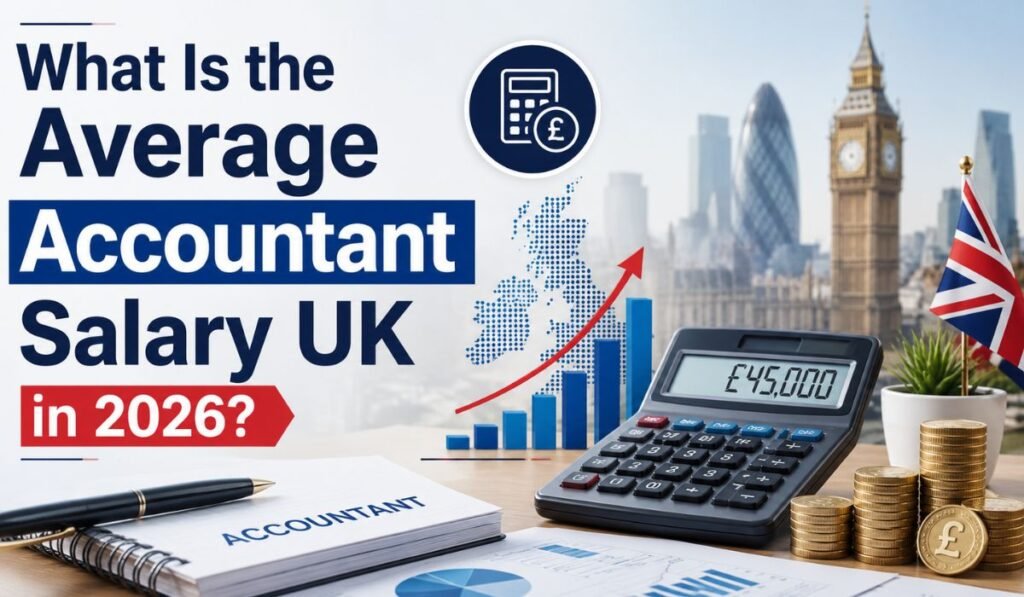
Based on the updated industry surveys and recruitment data, the average salary of accountants nationally in the UK in 2026 stands around £48000 per year. All figures are gross annual pay and exclude tax and National Insurance and relate to fully qualified professionals with reasonable experience.
But, this average represents just half the story. Accountancy salary UK range is very wide – from £23,000 for trainees & entry level roles to £150,000+ for senior chartered accountants and finance directors in a large company.
Accountant Salary UK by Experience Level
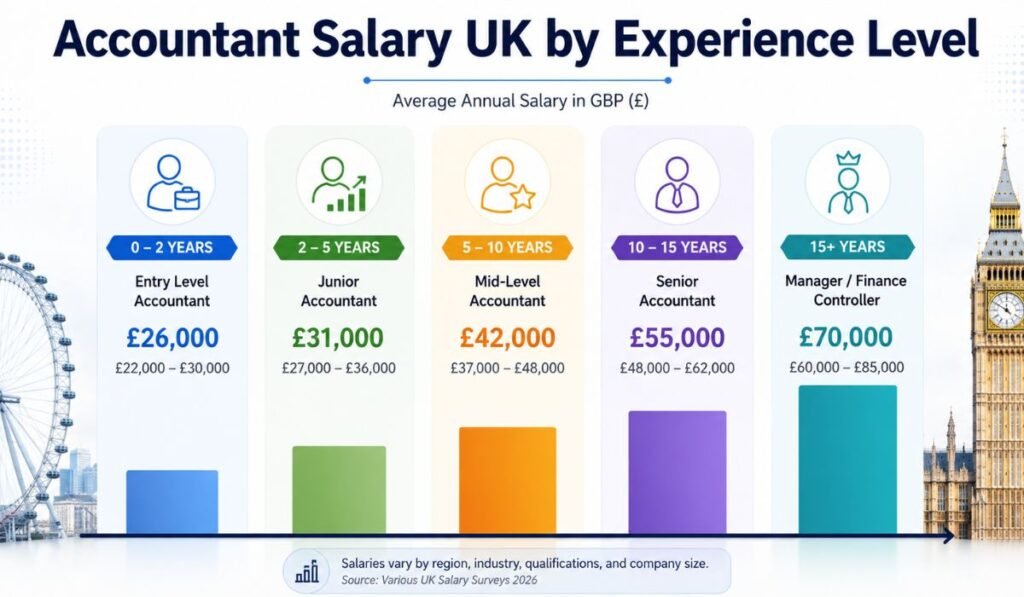
The most significant factor that drives earnings in the accounting profession is experience. The increase from trainee to fully qualified can more than double your salary, and movement into management and director positions can easily take pay past six figures.
Table 1: Accountant Salary UK by Career Stage (2026)
| Career Stage | Typical Salary Range | Monthly Equivalent |
| Trainee / Graduate (0–1 year) | £23,000 – £30,000 | £1,917 – £2,500 |
| Junior Accountant (1–3 years) | £28,000 – £38,000 | £2,333 – £3,167 |
| Part-Qualified Accountant | £35,000 – £50,000 | £2,917 – £4,167 |
| Newly Qualified (ACA/ACCA/CIMA) | £50,000 – £65,000 | £4,167 – £5,417 |
| Senior Accountant (5–8 years) | £60,000 – £80,000 | £5,000 – £6,667 |
| Finance Manager / Controller | £70,000 – £95,000 | £5,833 – £7,917 |
| Finance Director / CFO | £100,000 – £200,000+ | £8,333 – £16,667+ |
The salary of an entry-level accountant usually ranges from £23,000 – £30,000. After obtain their chartered qualification, be it ACA, ACCA or CIMA, professionals typically experience a decent salary increase, with newly qualified accountants on average earning £50,000 to £65,000 across the UK. At the higher end of the scale, experienced chartered accountants in large organisations can earn £90,000 to £130,000, while finance directors can effortlessly attract packages north of £150,000.
Accountant Salary UK by Qualification
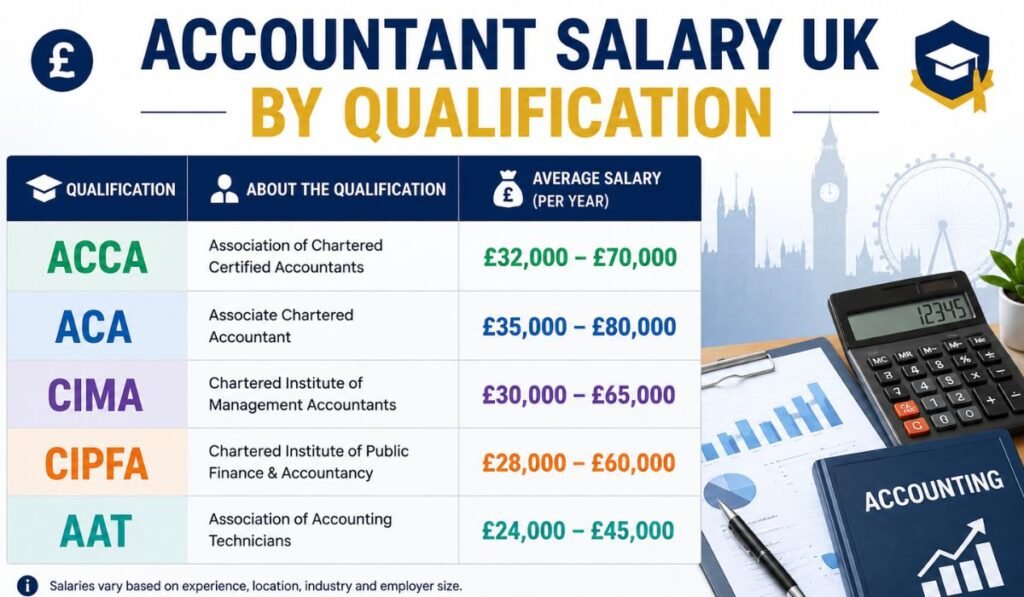
The largest salary differentiator in UK accounting is a professional qualification. Both the ACA (ICAEW), ACCA and CIMA are the one of the three major pathways you can take to become an accountant, and all of which massively increase your earning potential as an accountant in the UK.
Table 2: Accountant Salary UK by Qualification (2026)
| Qualification | Typical Salary Range | Best Suited For |
| AAT (Unqualified/Trainee) | £22,000 – £32,000 | Entry-level bookkeeping, practice support |
| ACCA (Part-Qualified) | £30,000 – £48,000 | Audit, tax, financial reporting |
| ACCA (Fully Qualified) | £50,000 – £75,000 | Corporate finance, practice, industry |
| ACA / ICAEW | £55,000 – £90,000 | Big Four, corporate finance, M&A |
| CIMA (Fully Qualified) | £55,000 – £85,000 | Management accounting, FP&A, FTSE companies |
| CTA (Tax Adviser) | £60,000 – £100,000+ | Tax advisory, specialist boutique firms |
When it comes to corporate finance and mergers and acquisitions, the ACA qualification, awarded by the ICAEW, opens up the most doors. Graduates are put through rigorous training on starting packages of £30,000–£35,000 in London at the Big Four, as they qualify after about three years on £55,000–65,000 (audit roles). More significant than any salary increase in the tax profession, the CTA (Chartered Tax Adviser) qualification remains the singular qualification which provides the widest salary uplift typically, qualified CTAs earn between 20–35% more on average than ATTs.
Accountant Salary UK by Region
Of all the factors that impact the accountant salary UK professionals receive, location is the most significant one. London, the financial hub of the UK, always pays top dollar, while regional cities such as Manchester and Birmingham and Edinburgh are beginning to compete.
Table 3: Accountant Salary UK by Region (2026)
| Region | Average Accountant Salary | vs. National Average |
| London | £63,000 | +31% |
| South East | £58,000 | +21% |
| Scotland (Edinburgh/Glasgow) | £52,000 | +8% |
| Manchester | £52,000 | +8% |
| Birmingham | £50,000 | +4% |
| Leeds / Yorkshire | £48,000 | Avg. |
| Bristol / South West | £47,000 | -2% |
| Wales / Northern Ireland | £40,000 – £44,000 | -8% to -17% |
Newly qualified accountants earn £50,000–£70,000 and senior managers £80,000–£120,000 or more while Londoners continue to rule the roost. London’s premium over the rest of the UK has been 25–35% historically. Cities like Manchester, Birmingham and Edinburgh sit 10 15% above the national average for pay but without the London cost of living escalating them out of the market with some strong progression opportunities available to them. Meanwhile, Northern Ireland and Wales consistently fall short of the national average, although wages in such regions are also creeping up year on year.
Accountant Salary UK by Sector and Employer Type
Your area of practice has a dominant effect on the accountant salary UK you will earn. Financial services, tech, and Big Four are almost always higher, and the public sector low but steady with decent pension at lower base salaries.
Table 4: Accountant Salary UK by Employer Type (Newly Qualified, 2026)
| Employer Type | Salary Range (Newly Qualified) | Key Benefits |
| Big Four (Deloitte, EY, KPMG, PwC) | £55,000 – £68,000 | Bonus 10–15%, pension, private medical |
| Investment Bank | £65,000 – £85,000 | Large performance bonuses |
| FinTech (Revolut, Wise, Monzo) | £58,000 – £80,000 | Equity, flexible working |
| Mid-Market Industry / Commerce | £48,000 – £60,000 | Work-life balance, varied role |
| Public Sector (NHS, HMRC, Councils) | £38,000 – £52,000 | Defined-benefit pension, job security |
| SME / Small Practice | £35,000 – £50,000 | Broad experience, client variety |
Though Big Four firms offer top salaries, they are infamous for demanding long hours, especially over the busy season. Investment banks pay the highest base salaries for accountants transitioning into finance, as well as sizable performance bonuses that can boost total compensation dramatically. Of course you will compete with FinTechs like Revolut, Wise, Monzo offering equity in addition to a strong base pay. Yes the public sector pays less in base salary than the private sector, which is like saying you can get more cake if you pay for it, but benefits like job security and defined-benefit pension schemes are worth a lot more than cake, particularly in the long run.
Key Factors That Influence the Accountant Salary UK
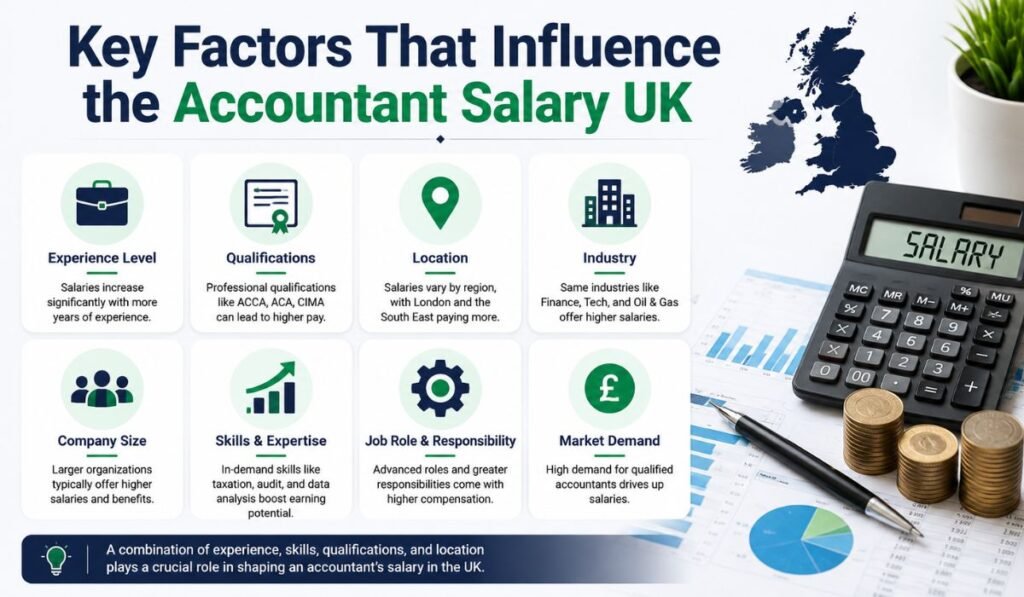
Evaluating the accountant salary UK market entails more than averages. A.c. which one professional falls in terms of salary is determined by the interaction of several elements.
- Professional Qualification: Holder of ACA, ACCA, and CIMA earns significantly higher than unqualified It is also important which qualification you choose: ACA generally attracts higher salaries in practice and corporate finance, whereas CIMA is more suitable for management accounting in industry.
- Experience and Seniority: An accountant salary UK earns around double as a senior than they do at the entry-level. That is, each year of post-qualification experience typically translates into £2,000–£5,000 higher base salary, with bigger jumps on promotion into management grades.
- London organisations pay 25–35% more than the national average. Your location matters even within London the City and Canary Wharf pay better than outer borough roles.
- Firm Size and Type: Multinational corporations and Big Four firms pay around 20–30% premium than local companies for similar roles. We do know that while SMEs have a lot of experience, the breadth of experience and the potential for more speed to seniority often come from those whom we have put in the category of generalist.
- Specialisation: Senior roles in the fields of tax, corporate finance, forensic accounting and auditing can fetch higher salaries. CTA qualified tax accountants and forensic professionals can earn very healthy salaries.
- Bonuses and Perks: Most accountants, particularly those in financial services, earn bonuses of 10–20% of base salary. More senior posts normally offer total compensation packages that include private medical insurance, higher pension contributions, season ticket loans, and share schemes.
Freelance and Contract Accountant Rates in the UK 2026
Freelance and contract accountants might choose to earn more money per hour or per day as these accountants do not receive holiday pay, pension contributions or other benefits enjoyed by permanent workers. In 2026, the accountant salary UK equivalent for contractors usually looks as follows:
- Junior/Part-Qualified (Contract): £150–£250 per day
- Contract: Qualified Accountant From £300.00 to £500.00 per day
- Contract Senior Finance Manager: £500 – £700 per day
- Interim Finance Director: £700-£1,200 per day
Freelancers who work with specialist advisory services or with niche areas, such as R&D tax credits, transfer pricing or forensic accounting can cross the ranges mentioned above.
Career Progression and How to Maximise Your Accountant Salary UK
You have to make sure all the strategies that prove to be helpful in accountant salary UK. However, getting a recognised professional qualification ACA, ACCA or CIMA continues to be the only real way to seriously boost your earnings. These qualifications pay for themselves quickly, often recouping training costs in the one to two years following qualification, making for a great return on investment.
You are trained in an area that will be significantly over the national average by gaining experience in a higher paying industry (financial services, tech, consult) Strategic transitions between the public and private sector can also be important to achieve salary jumps that an internal promotion may not necessarily deliver.
Third, to have at least a part of your career in London or the South East builds a salary record that will still hold up when you move elsewhere. Finally, focusing on in-demand areas like tax advisory, ESG reporting or fintech makes you a much more desirable recruit.
5 Frequently Asked Questions About Accountant Salary UK
Q1. What is the starting accountant salary UK for a graduate in 2026?
The salary for a graduate trainee accountant in the UK is between £23,000 and £35,000 depending on the employer and location. Starting salaries are, however, higher at Big Four firms in London, generally between the £30,000 to £35,000 mark. Regional employers with smaller practices are generally beginning at about £23,000–£28,000.
Q2. How does the accountant salary UK change after qualification?
Both ACA, ACCA or CIMA qualifies provide one of the largest salary increases any profession can offer. The UK salary of an accountant rises to £50,000–£65,000 across the UK for newly qualified accountants, compared with £30,000–£45,000 at the part-qualified level. The rise is even sharper in London, where starting salaries for newly qualified accountants leap to £55,000–£70,000 or more;
Q3. Is the accountant salary UK higher in London than the rest of the country?
Yes, significantly. Accountant salaries London averages out at around £63,000, which is 31% higher than the UK national average of about £48,000. Salaries for senior roles range from around £180,000 in London for finance directors to £120,000–£140,000 for regional counterparts. The premium in London does partly represent the costs of the capital, but accountants from mid to senior levels are absolute better off in London as compared to other cities.
Q4. What qualifications increase the accountant salary UK most?
None of the accountancy qualifications (ACA (ICAEW), ACCA and CIMA) have such a massive impact on the accountant salary UK. The highest salaries in corporate finance and Big Four practice are usually for the ACA, while CIMA dominates industry and management accounting. The CTA qualification also offers the largest salary premium within tax advisory. Each of these are likely to increase your earning potential significantly when compared to being unqualified or holding just an AAT.
Q5. Can accountants earn more as freelancers or contractors in the UK?
Yes. Mid to senior level freelance / contract accountants command significantly higher day rates than their permanent counterparts. In the UK, most contractors can expect to earn between £300-£500 per day in return for far greater work/life balance, not to mention the ability to control their own workload and clients — usually signifying an annual salary higher than a permanent appointment. Contractors must save tax, pension and benefits for themselves, so the comparison is an exercise in financial planning.
Summary
The accountant salary uk in 2026 represents a profession that pays well for qualification, experience and specialisation. Whether you’re about to graduate, working through your ACCA or ACA exams or a full-fledged chartered accountant considering your next move, the insights above give you the context you need to negotiate intelligently and make significant career decisions.
The major things to note is simple be qualified, pursue right sector and city and have a specialisation where the demand is high. In doing so, you open up the full range of the accountant salary UK has to offer from a safe low-to-mid-twenties base in your first job to genuinely high six-figure packages at the very highest levels of the profession.

Dalvi is a passionate content writer and digital researcher associated with SalarySlip.co.uk, specializing in finance, salary insights, and career guidance. With a strong focus on delivering accurate and user-friendly information, Dalvi creates well-researched content that helps readers understand payslips, tax structures, and income-related topics. Backed by a keen interest in SEO and digital trends, Dalvi ensures every article is informative, engaging, and optimized for search engines, making complex financial concepts simple and accessible for everyone.