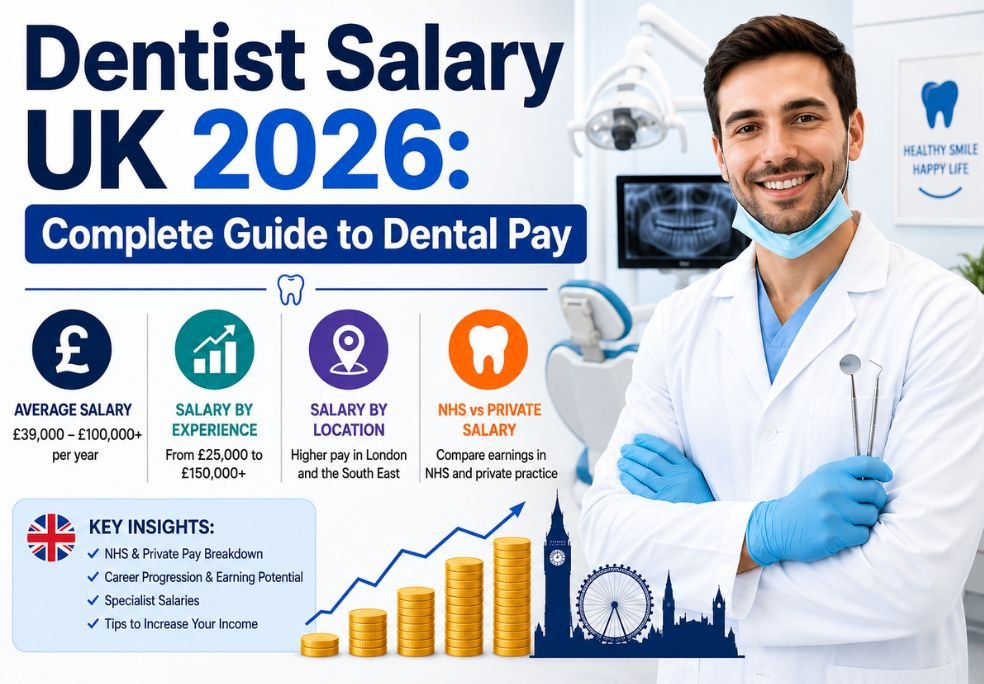
Across the sector, UK dentist salary 2026 is among the most financially lucrative. Thanks to salary information as a whole, you know the direction of dental graduate salaries, new NHS Associate pay rates and what a dentist salary UK looks like at varying stages into your career. Dentistry always ranks among the best-paid professions in the UK, with salaries well above the average national wage of £35,464.
In the UK, the dental profession may be split into two main sectors NHS and private practice. In the UK, a dentist salary can vary dramatically depending on what level of experience you have and whether you are currently employed by the NHS or working privately; with information sourced from sites such as Glassdoor, PayScale, Indeed & official NHS pay bands indicating that those just starting out can expect £40k in their first years of practice or £150k+ if they become an experienced specialist/practice owner.
In this detailed guide, we dissect the dentist salary UK by experience level, specialisation, region and employment type providing you with the most accurate picture available for 2026.
Average Dentist Salary UK 2026: Key Figures
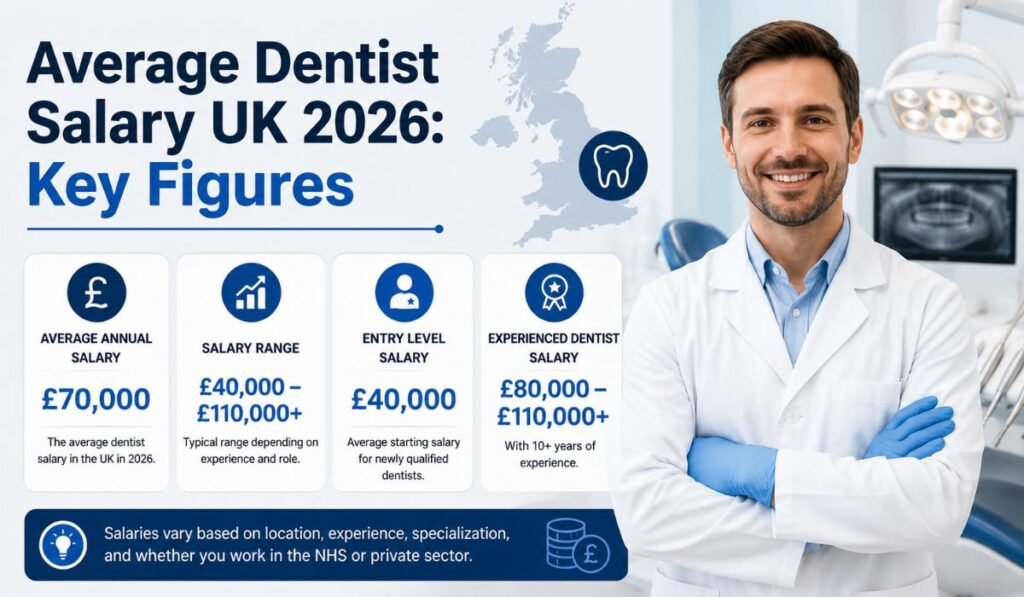
Several salary databases offer a similar view of dentist pay in the UK (2026). A salary that came second but still doesn’t really reflect the reality of how much dentists in the UK are paid, at least not on average, according to Indeed who also present over 6,900 salary reports and yet again May 2026 results show an average dentist salary UK: £87,524/year Glassdoor suggests an average of £60,296 while PayScale says the figure is £54,045 from reported profiles. Then they vary by method and NHS versus private split.
| Source | Average Dentist Salary UK | Range |
| Indeed (6,900+ reports, May 2026) | £87,524 per year | £41,000 – £132,000 |
| Glassdoor (282 reports, May 2026) | £60,296 per year | £41,409 – £136,650 |
| PayScale (89 profiles, 2026) | £54,045 per year | £29,000 – £132,000 |
| NHS Pay Scale (Salaried, 2026/27) | £52,532 – £112,360 | Foundation: £40,776 |
| Private Practice (Estimates) | £80,000 – £150,000+ | Associate: 40–50% gross |
| London Average (ERI 2026) | £130,406 per year | £87,633 – £160,790 |
Read Also:- Immigration Salary List 2026
NHS Dentist Salary UK 2026/27: Official Pay Scales
The NHS has one of the most well laid out salary every framework for dentist salary UK. The NHS across England, Wales, Scotland and Northern Ireland also changed its pay bands for dental professionals from April 2026. This information will be most useful for salaried dental officers, foundation dentists, coretrainees and consultant-grade specialists.
| NHS Career Stage | Annual Salary (2026/27) | Notes |
| Foundation Dentist (Year 1) | £40,776 | Mandatory training year; updated from £37,000 in 2024 |
| Dental Core Trainee (DCT) | £54,499 – £67,325 | +37% night enhancement; weekend allowance applicable |
| Specialty Trainee | £65,048 – £73,992 | May qualify for flexible pay premiums |
| Salaried NHS Dentist (Community) | £52,532 – £112,360 | Stable employment; full NHS benefits |
| Consultant Dentist | £109,725 – £145,478 | Clinical Excellence Awards: £4,000–£75,000+ extra |
Finally, it is also worth noting that most NHS dentists working in general dental practices are not salaried employees, but self-employed contractors employed by a practice or not even directly employed at all. These associate dentists are paid on a per Unit of Dental Activity (UDA) basis, with UDA values usually between £20 and £35 depending on NHS contract and area. As a result, their real dentist salary UK varies greatly depending on the number of patients treated and the types of treatments available.
Private Dentist Salary UK 2026: Higher Earning Potential

Private practice is the top earners side of the dentist salary UK range. With no NHS UDA contracts for private dentists, this means they can charge their own fees and set their prices (charging more for cosmetic/elective treatment) and also keep much higher margins on whatever they bill.
Most associate dentists would make 40–50% of their gross billings in a private practice. High-performing private associates can earn significant sums of money, well beyond that which NHS counterparts may expect, particularly with the value an active patient list and high-value treatments such as clear aligners (such as Invisalign), dental implants and veneers offer.
| Private Practice Role | Typical Annual Earnings | Key Driver |
| Private Associate Dentist | £60,000 – £120,000 | 40–50% of gross billings |
| Mixed Practice (NHS + Private) | £65,000 – £100,000 | Balanced patient base |
| Private Practice Owner | £100,000 – £200,000+ | Business profits + clinical income |
| Cosmetic Dental Specialist | £90,000 – £150,000 | Implants, veneers, Invisalign |
| Self-Employed General Dentist | £77,000 (avg taxable) | Fee-per-item charging |
Recent estimates suggest private dentists can earn £140,000 or more a year with a strong portfolio of specialist treatments. Private sector dentist salary UK compensates with greater advantages for investment in continuing professional development (CPD), advanced certifications, and relationship management with patients.
Read Also:- Salary Finance UK
Dentist Salary UK by Experience Level
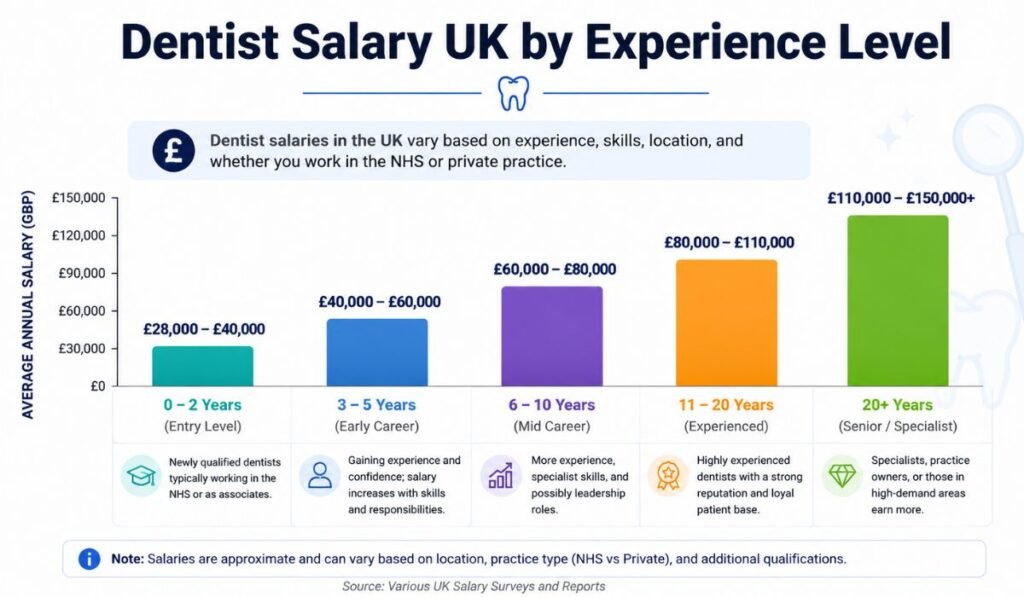
Career progression is one of the influential factors determining dentist salary UK. The earnings of dentists can experience a rapid acceleration with clinical experience, the growth of their patient trust and if they are either skilled or knowledge in a specific area once again, doubling frequently within the first five to seven years.
| Experience Level | Years in Practice | Average Annual Salary UK |
| Entry Level / Foundation | Less than 1 year | £38,472 – £40,776 |
| Early Career | 1 – 4 years | £40,695 – £55,000 |
| Mid-Career | 5 – 9 years | £60,000 – £85,000 |
| Experienced | 10 – 19 years | £80,000 – £110,000 |
| Senior / Late Career | 20+ years | £100,000 – £150,000+ |
Important note, UK-average dentists are earning more than double the national median income at Year 5. In conjunction with high job security, this leads to one of the most financially attractive long-term care paths within the UK healthcare system.
Dentist Salary UK by Specialisation 2026
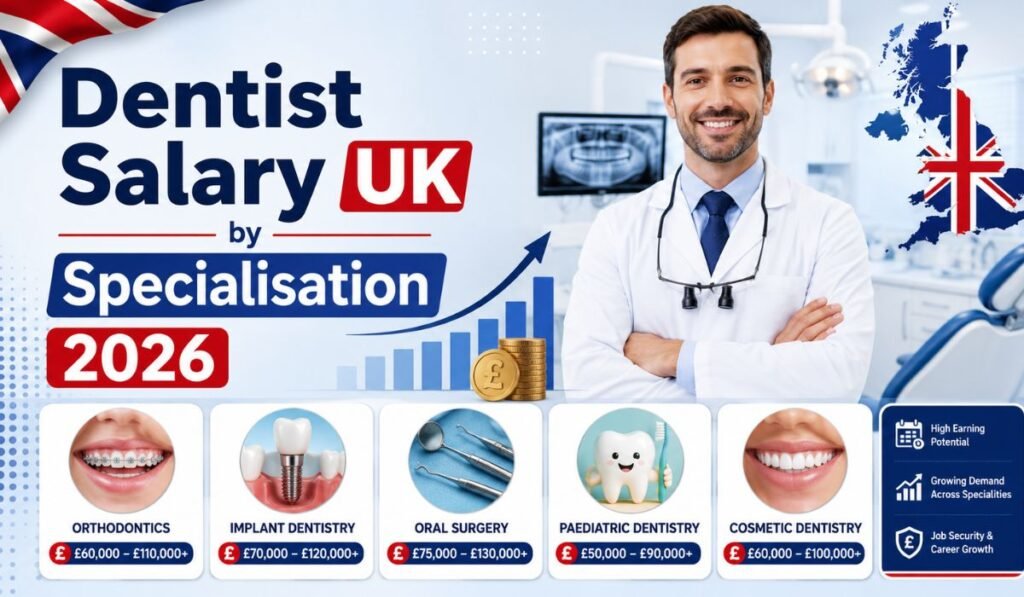
A dentist salary UK can be greatly increased by using specialisation as one of the most powerful levers. Dentists also can progress to higher consultant pay grades and conduct complex and greater-value strategies via completing extra accredited postgraduate training. Dentist salary UK of different dental specialities can contrast considerably.
| Dental Specialisation | Annual Salary Range (UK 2026) | Demand Level |
| Orthodontist | £35,000 – £96,000 | Very High |
| Oral & Maxillofacial Surgeon | £80,000 – £145,000+ | Very High |
| Periodontist | £55,000 – £100,000 | High |
| Endodontist | £55,000 – £95,000 | High |
| Prosthodontist | £60,000 – £110,000 | High |
| Paediatric Dentist | £52,000 – £90,000 | Moderate–High |
| Cosmetic Dentist (Private) | £70,000 – £150,000 | High |
| Dental Public Health Specialist | £65,000 – £112,000 | Moderate |
| Implantologist (Private) | £80,000 – £150,000+ | Very High |
Dentist salary UK – Oral Surgery and Orthodontics are always in our pay league tables at the top. Consultant grade surgeons on the NHS scale earn up to £145,478 with additional Clinical Excellence Awards and experienced professionals in these areas typically make more than £96,000 a year. For private practice, the top-grossing segments of dentistry are implantology and cosmetic-related treatments.
Read Also:- Nurse Salary UK
Dentist Salary UK by Region and City 2026
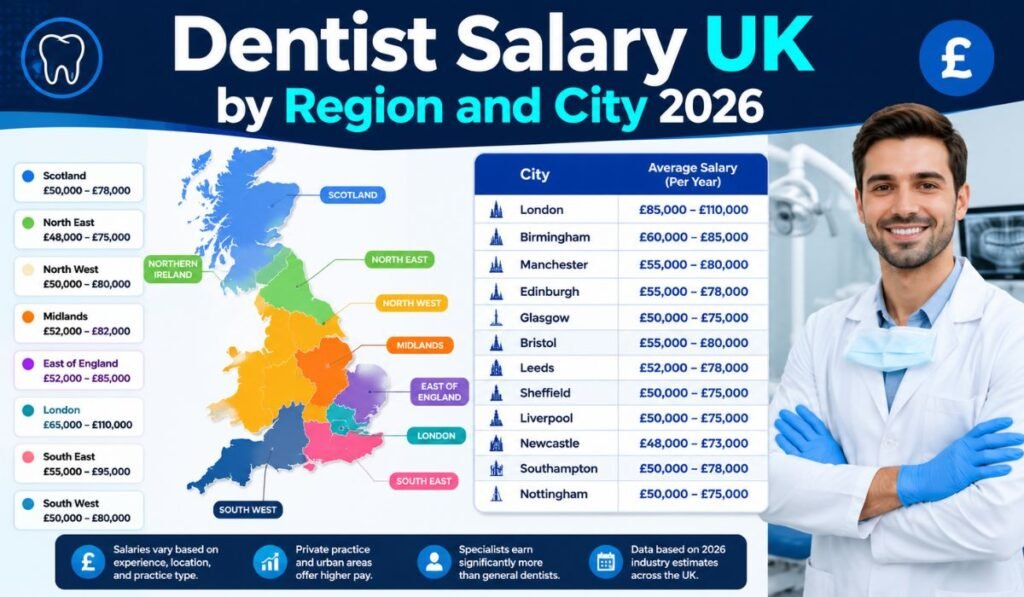
Geography has an important part to play in the dentist salary UK. Salaries are highest in London and the South East, due to higher living costs coupled with increased patient demands and a larger concentration of top-end private practices. But in other areas, average dentists may take home more after lower housing costs and overall living expenses are factored in.
| Region / City | Average Dentist Salary UK | Notes |
| London | £130,406 (range: £87,633–£160,790) | Highest nominal pay; highest cost of living |
| South East England | £75,000 – £100,000 | Strong private practice market |
| Manchester | £65,000 – £90,000 | Growing private dental market |
| Birmingham | £60,000 – £85,000 | High NHS patient demand |
| Edinburgh / Scotland | £62,000 – £88,000 | NHS Scotland separate pay scales |
| Cardiff / Wales | £58,000 – £82,000 | NHS Wales; slightly lower UDA values |
| Belfast / N. Ireland | £56,000 – £80,000 | Separate NHS NI framework |
| Newcastle upon Tyne | £60,000 – £85,000 | Good NHS demand; lower CoL |
| Bristol | £65,000 – £90,000 | Strong mixed practice market |
| Plymouth | £58,000 – £82,000 | High NHS demand region |
If you are looking for disposable dentist salary UK then cities like Manchester, Bristol and Newcastle provide attractive offers which include competitive wages alongside tremendously reduced living costs compared to London.
NHS vs Private: Comparing the Dentist Salary UK
Which practice offers the best overall package, NHS or private is one of the most hotly contested questions amongst UK dental professionals. Beyond the basic salary, the UK dentist salary comparison between these two paths includes job security, pension contributions, workload types and patient mix factors as well as autonomy in clinical decision making.
| Factor | NHS Dentist | Private Dentist |
| Average Salary | £52,532 – £112,360 (salaried) | £60,000 – £150,000+ |
| Pay Structure | Fixed salary or UDA payments | % of billings (40–50%) |
| Job Security | High – NHS employment contract | Variable self-employed |
| Pension | Excellent NHS pension scheme | Must fund independently |
| Annual Leave | Full NHS entitlements | Unpaid when not working |
| Patient Volume | High NHS waiting lists | Moderate private bookings |
| Clinical Autonomy | Limited by NHS frameworks | High own fee schedule |
| Work-Life Balance | More predictable hours | Flexible but irregular |
| Career Progression | Structured pay bands | Income-driven progression |
| CPD & Training | Funded by NHS | Self-funded investment |
Most UK dental professionals choose to work in a hybrid model between NHS and private sessions. This model offers a middle-ground between NHS income security and higher earnings through private practice. The ideal portion relies upon your monetary objectives, danger hunger and the patient populace in your area. A dentist salary uk of anywhere in between £65,000 and £100,000 (depending on the area) is common with hybrid practitioners during this stage, but as they build up their private patient list there can be massive upside potential.
Read Also:- GP Salary UK
Practice Ownership: Maximising Dentist Salary UK
Practice ownership is the summit of that earning potential in the NHS-remapped dentist salary UK spectrum. Owning a dental practice comes with extra business risk and management responsibility, as well as huge upfront capital investment needed to get started but the financial rewards are life-changing; many practices owner report annual total incomes of £150,000 to even £200,000 or more.
It is made up of a convincing mix of NHS and private patients, the treatments available, number of dental chairs and sound business management that are key revenue drivers for the practice. Corporate players like the likes of myDentist and Damira Dental Studios are increasingly becoming major dental employers with competitive associate packages, however overall ownership of an independent practice tends to achieve the highest earnings as part of a 12 month period.
Key Factors That Influence Dentist Salary UK

Defining data that impact the dentist salary UK is essential to accelerating the paycheck for any practitioner. There are multiple interrelated factors that will dictate the extent of your earnings in this wide salary range.
1. Experience and Seniority
Throughout this guide, we have highlighted repeatedly how experience is possibly the single largest predictor of dentist salary UK earnings. Every year you spend in clinical practice means more trust, more referrals, and better efficiencies in procedural work all leading into a larger income.
2. Specialisation and Postgraduate Qualifications
A specialty qualification for example, a membership of the Royal College of Surgeons (MRCS) or a postgraduate diploma in implantology can greatly enhance the dentist salary UK. Not only do specialists receipt larger fees per treatment received, but also meet the criteria for higher NHS consultant pay scales as well.
3. NHS vs Private Sector Split
The split between work done for the NHS or in private practice directly affects earnings. Private dentist salary NHS roles have more job security with added benefits such as the NHS pension, but dentists make more per treatment in private practice.
4. Geographic Location
As shown in our previous regional table, the location of practice has a big impact on dentist salary UK. There is a premium to living in London, but real-terms income growth will also depend on regional cost of living factors.
5. Type of Employment
A salary provides paid leave and predictable income for dentists (for the most part) on a full-time basis. Self-employed associates earn a larger proportion of their billings but have fluctuating incomes. Exercise owners are paid for then live clinical work as well as the income profit which comes from this business.
6. Digital Dentistry Skills
In the private market, you can increasingly get rewarded for adopting technologies such as digital scanning, CAD/CAM restorations, and AI powered diagnostics. Dentists that acquire these skills can provide high-end treatments, which increase their overall UK salary as dentist.
Dentist Salary UK 2026: Future Trends and Outlook
The future projections for the dentist salary UK 2026 (and beyond) are positive, backed up by various structural changes increasing demand for dental care and feeding pay growth through the profession.
- Ageing Population: The increasing older population in the UK requires more complicated dental treatment; thus, prosthodontics and oral cancer screening are part of dentistry for older people and raised popularity in implant increase dentists demand.
- NHS Dental Crisis: Continuing NHS dental waiting lists are pushing ever more patients to visit private practice increasing the private dental market and enabling higher generations of UK dentist wage.
- Surge in Digital Dentistry to Deliver New Revenue: Artificial intelligence diagnostics, 3D printing and digital scanning will deliver higher value treatment for practices.
- UK NHS changes to contracts: As some are still ongoing currently, the NHS dental contract reforms could have a significant impact on UDA values and payment structures ie.
- International Dentist Demand: The UK remains a destination of choice for overseas dentists (notably, from India and the EU) putting some support behind workforce supply as dentist salary UK levels are more attractive than many home countries.
- Rise of Cosmetic Dentistry: The growth of the cosmetic dental sector with roots in social media and celebrity culture is generating lucrative income potential for private practitioners.
The dentist salary UK is projected to grow reasonably well in nominal terms over the near term, although there are a number of caveats to this forecast, with strongest increases found for specialist and private practitioners. NHS pay rises will continue to be negotiated every year, with the government offering recently behind inflation uplifts over recent years in bid to tackle recruitment and retention issues.
How to Maximise Your Dentist Salary UK
Here are the top five 5 ways for dental practitioners looking at how to optimse their dentist salary UK based on current market trends.
- Specialise strategically; Opt for specialities that guarantee the most demand and best remuneration such as oral surgery, orthodontics or implantology.
- Invest in private practice: You can also consider investing some time to build a private patient list alongside your NHS commitments to capitalise on the higher earnings available through private dentistry.
- Look into practice ownership: Though riskier, owning a practice offers the most opportunity for earnings at the top of the dentist salary UK range.
- Digital dentistry: Dentistry associated with various certifications such as Invisalign, dental implants and digital workflow activity are priced higher.
- Make smart location decisions: weigh the earning potential against cost of living – Bristol and Manchester have largely the same returns but lower overall living costs than London.
- Clinical Excellence Awards: These can earn NHS consultants between £4000 and £75,000+ on top of the base dentist salary UK.
- Negotiate your associate split: Self-employed associates are best off securing the maximum percentage of billings for themselves that they can, i.e. 50% wherever feasible
FAQs: Dentist Salary UK
Q1. What is the average dentist salary UK in 2026?
According to different data sources, the dentist salary UK average in 2026 is around £54,000–£87,500. Running an NHS salaried dentist: £52,532–£112,360 and running a dentist as a private practitioner may be paid as standard between £60,000-150,000+. Based on 6,900+ salary reports, indeed lists a general average of £87,524.
Q2. How much do NHS dentists earn in 2026?
The new salaries will see NHS foundation dentists begin with a £40,776 annual salary. Full NP65 (Dental core trainees) = £54,499–£67,325 from April 2026 The salaries for salaried NHS community dentists (SDS) range from £52,532–£112,360; consultant dentists’ pay ranges from £109,725–£145,478 plus allowances for Clinical Excellence Awards.
Q3. Do private dentists earn more than NHS dentists?
Yes, in most cases. Dentist salary UK private practice typically pays higher than NHS rates, especially for those with more experience. Private associates will earn between 40–50% of gross billings, and if you are really successful with private work as a dentist you can look to be earning £100,000–150,000+. But NHS dentists have more job security, a valuable NHS pension and paid holidays.
Q4. What is the highest dentist salary UK?
Practice owners and specialist consultants working in private practice earn the highest dentist salaries UK. Earnings of £150,000–£200,000+ for practice owners and in excess of £145k annual earnings for top private specialists (especially oral surgeons/implantologists) The top earners those at the 90th percentile raking in £136,650, according to Glassdoor.
Q5. Which dental specialisation pays the most in the UK?
The most lucrative dental specialisation in the UK are Oral and Maxillofacial Surgery and Orthodontics, where specialists can earn £96,000 – £145,000 + per annum for experienced positions. Private practice cosmetic implantology can likewise produce really high earnings.
Q6. How does location affect dentist salary UK?
Dentist salary UK Location Effects on Earnings Nominally, the highest pay for London dentists with an average of £130,406 a year – but they also have the most expensive cost of living. Similar dentist salary UK figures tend to be also lower in locations like Manchester, Bristol, Edinburgh and Newcastle as a result of far cheaper living expenses (leading to higher disposable incomes).
Q7. What is the dentist salary UK for newly qualified graduates?
Newly qualified dentists in the UK have to now do a year of foundation training with an annual salary of £40,776 (2026/27 rate). In contrast, associates have a typical starting salary post-foundation training of £40,695–£55,000 and this rises rapidly with experience.
Q8. Can overseas dentists work in the UK and what do they earn?
International dentists can practice in the UK once they are accepted into the Overseas Registration Exam (ORE) attend and register with the General Dental Council (GDC). This process usually takes around 1–2 years. Overseas dentists that pass their registration exams can expect to be paid the same dentist wage UK pay scales as instate grads, starting at £40k foundation level and going beyond £100,000+ depending on experience.
Q9. Is dentistry a good career financially in the UK in 2026?
Yes dentistry continues to be one of the more lucrative careers in UK healthcare. Newly qualified dentists earn significantly more than the average UK wage, with a national average of £35,464. Dentist Salary UK trajectory You are looking at a very solid dentist salary career, usually the sort of income doubles the UK median income within 5 years post-qualifying! It combines high earnings with job security and potential for growth into private practice or ownership, making it a highly attractive financial career choice.
Q10. How does the dentist salary UK compare internationally?
Dentist salary UK packages are good in comparison to many countries. The UK is far more appealing, where a general dentist in India will earn £7,000–£17,000 each year. Top end salaries are bigger in the US (c£180,000+) but the NHS benefits, pension and lower medical protection insurance costs make it extremely competitive on an overall compensation basis.
Conclusion: Is the Dentist Salary UK Worth It in 2026?
The dentist salary UK in 2026 offers a persuasive financial argument for any would-be dental careerists or those wanting to make the most of their current dental career. From the set wage scales of NHS pay bands to the very lucrative private specialist practice, the dentist salary UK range provides a strong basis whether you are risk averse and prefer high security or can take on more uncertainty in return for better remuneration.
Summary of this guide: The average dentist salary UK varies from £40,776 for foundation dentists to over £145k for NHS consultants with private practitioners and practice owners frequently earning in excess of £150k per year. Mastering a field say oral surgery, orthodontics or implantology and going private is the path of least resistance to top dentist salary UK income.
The dentist salary UK has a bright future for the continuation of growth, and with an ageing population, enormous NHS waiting lists pushing patients into private care & the digital dentistry revolution making new revenue streams it really is in pole position for success through to 2026 & beyond. However, whether you are newly qualified or a seasoned pro, it is vital that you keep an eye on how salary benchmarks change over time as well as the latest NHS pay updates and private practice trends.

Dalvi is a passionate content writer and digital researcher associated with SalarySlip.co.uk, specializing in finance, salary insights, and career guidance. With a strong focus on delivering accurate and user-friendly information, Dalvi creates well-researched content that helps readers understand payslips, tax structures, and income-related topics. Backed by a keen interest in SEO and digital trends, Dalvi ensures every article is informative, engaging, and optimized for search engines, making complex financial concepts simple and accessible for everyone.