
In today’s economy, high prices affect daily life for everyone. Food, gasoline, housing, health care – the cost of living keeps on going up from year to year. To help employees cope with rising prices, a considerable component in salary called Dearness Allowance is given by most organizations, especially government departments. This allowance is designed to protect the purchasing power of employees and ensure that their income will keep up with inflation.
Dearness Allowance is a key part of wage structures in India. It is regularly granted to government employees, pensioners, and occasionally also private sector employees. As inflation directly affects family budgets, Dearness Allowance becomes a necessary part of remuneration. Understanding how Dearness Allowance operates helps employees more accurately calculate their salary and plan their financial budgets.
This comprehensive guide covers everything about Dearness Allowance, including definition and which types are available, how to calculate it, tax provisions, the benefits and drawbacks of each type, examples showing you just what it is that you get for your money, Questions answering your concerns about this matter or that with FAQs.
What is Dearness Allowance ?

Inflation Adjustment – If the price of living goes up, hurt workmen and public servants receive on cost grounds a salary on which they can live more cheaply. This practice leaves the worker with enough money to keep going through dearer times at little expense to the enterprise.
The rate of Dearness relief is a percentage which gets adjusted periodically according to inflation. The basic objective of Dearness Allowance; it helps workers to maintain their purchasing power in times when price levels rise.
As a matter of course, Dearness Allowance tends to start growing after inflation breaks out. At the same time, one discerns workers making fewer and fewer complaints about their living conditions.
D.A. is paid in India to:
- The Central Government Employees
- State Government Employees
- Employees of The Public Sector
- Pensioners
- Some employees in the Private Sector
Dearness Allowance is calculated by using the Consumer Price Index (CPI); when CPI rises, Dearness Allowance increases too! This means workers can keep pace with heightened living costs in a society that is full of upward revisions.
While Dearness Allowance is a dynamic component of salary, not so basic pay. Periodically (usually once every six months for government employees), it undergoes some change.
Why Dearness Allowance is Important
There is a great deal in mere words. And it’s true of “Dearness Allowance”. This sorts out all the gnashing of teeth. Without Dearness Allowance, the employee has to take a downward shift over inflation rate increases.
There are several benefits that Dearness Allowance brings to employees. It ensures that wages will rise without changing an employee’s basic wage. Financial stability is essential for the proper planning of long-term needs, such as insurance and education for children. But inflation! Unpredictable seizures at regular intervals. Is there still no hedge against it? Have people learned nothing as yet?
Key reasons why Dearness Allowance is important:
- It offers employees protection from the effects of inflation and rising living costs
- In addition to basic pay, total salaries can be raised
- Pensioners can maintain their standard of living post retirement
- It makes financial planning easier and helps to stick to a budget
- It is reviewed from time to time to match current economic conditions
As a result, Dearness Allowance has become one of the most important components in wages.
Types of Dearness Allowance
Dearness Allowance is split into different categories depending on the type of worker. These categories determine how Dearness Allowance is figured and where it is applied.
Industrial Dearness Allowance (IDA)
This kind of Dearness Allowance is mainly used in government-owned enterprises or PSUs. And because prices of industrial products change often enough that IDA needs revising more frequently than other kinds.
Industrial Dearness Allowance is provided to public sector employees. It is revised quarterly based on CPI. IDA helps industrial workers manage changing market prices.
Variable Dearness Allowance (VDA)
Variable Dearness Allowance is mainly given to central government employees. The scale of it is revised twice a year and on three factors:
- Consumer Price Index
- Base Index
- The government’s decision
Variable Dearness Allowance changes if it goes beyond a certain level with the rate of inflation.
How Dearness Allowance is Calculated
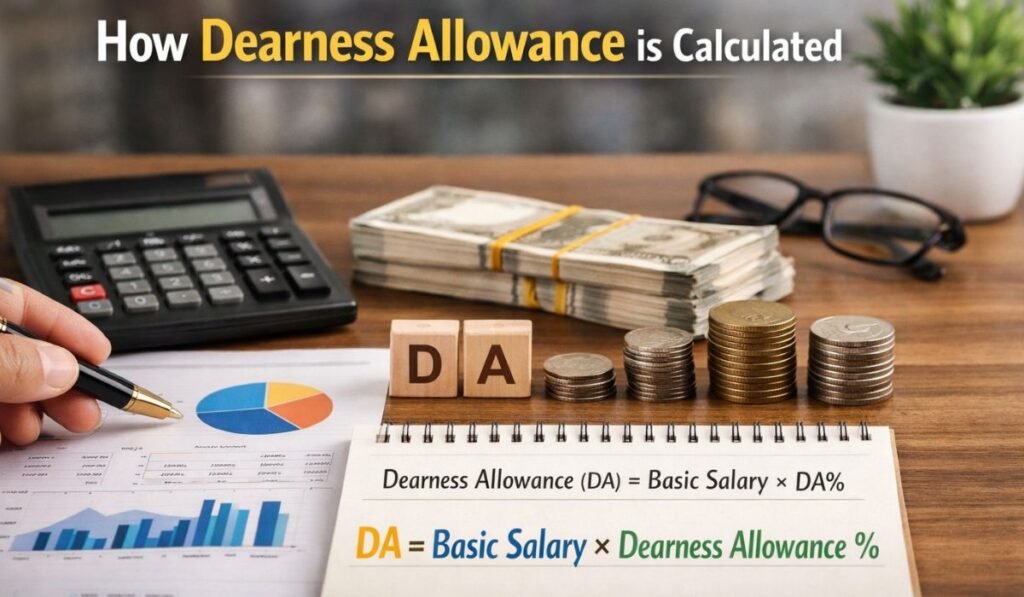
Dearness allowance is calculated as a proportion of the basic salary. The formula Dearness allowance is easy to understand, simple in logic.
General formula:
Dearness Allowance = Basic Salary × DA Percentage
An example to illustrate this:
Basic Salary ₹30,000
DA= 20%
DearnessAllowance=30000×20%=₹6,000
The total salary increases by ₹6,000.
Government employees apply the general formula. Dearness allowance percentage is calculated on the basis of inflation data. Once promised, the calculation is applied to the basic salary.
Dearness allowance calculation depends on the following:
- Basic salary
- DA percentage
- Rate of inflation
- Government policy instructions
Dearness Allowance Example (Salary Slip)
Using the example of a wage slip, let’s take a look at how dear allowance is calculated.
| Salary Component | Amount |
|---|---|
| Basic Salary | ₹25,000 |
| Dearness Allowance (30%) | ₹7,500 |
| HRA | ₹8,000 |
| Other Allowances | ₹3,500 |
| Gross Salary | ₹44,000 |
In this example, Dear’s Allowance increases are making big strides in salary. If you took away Dearness Allowance, the employee would, earn far less.
Dearness Allowance for Government Employees

Dear’s Allowance is most typical of local state jobs. Central government employees receive Dearness Allowance twice a year, in January and July. In advance of the final announcement of them new Dearness Allowance rate,time is taken by government to examine inflation data carefully.
- The Basic Salary of Dearness Allowance
- Pension amount
- Family pension
Thus the pensioner often benefits from a rise in Dearness Allowance. Whenever there’s increase in Dearness Allowanoe, pension too increases automatically
Government Dearness Allowance is important because:
- It protects state employees from inflation.
- It increases pension benefits
- It guarantees a fair rise in salaries
- It means financial security after a long time.
Dearness Allowance for Private Employees

Just like in the government service Dearness Allowance for private employees is not compulsory. Private enterprises have the flexibility to decide whether DA will be a separate salary item from basic pay or part of it. In some places, DA is included in the overall compensation package(CTC); while elsewhere it is offered strictly to cover rising prices and any gains will be lost if somebody has to stop working due illness or whatever.
In the private sector dearness allowance is available somewhat unevenly Large corporations, multinationals, and organisations with coherent HR policies are more likely to provide it startups and small businesses often either incorporate DA (or drop it for other benefits.
For private enterprise, the main factors determining Dearness Allowance are:
- Company Policy: Each company decides whether to offer Dearness Allowance and how often it will be revised. Some companies review the scheme yearly but others do so Pursuant performance cycles.
- Salary Structure: Companies with tiered pay bands tend to define Dearness Allowance as a designated portion. – This is done to maintain salary transparency.
- Industry Standards: Areas like banking, manufacturing and enterprises attached to the public sector are more likely to offer Dearness Allowance than IT startups.
- Inflation Adjustments: Some companies raise Dearness Allowance at regular intervals to keep up with the cost of living and maintain purchase power.
Although DA is not mandatory in the private sector, giving it helps businesses attract skilled professionals, increase employee satisfaction, and retain talent in competitive industries.
Tax on Dearness Allowance
Dearness Allowance is considered as part of salary and will be taxed under the Income Tax Act. Unlike the exemption for house rent allowance (HRA), there is no tax exemption on any part of dearness allowance. It will form part of the total salary received by an employee and be taxed according to the relevant income tax slab for that person.
When Dearness Allowance becomes part of your total salary, it also affects how much your taxes are. So men who are planning where to invest money in order to save taxes (e.g., with ELSS, PPF or insurance) need to take this into account.
The main tax rules applied to Dearness Allowance are:
- Please deduct tax before giving DA payments. Dearness allowance is fully taxable in the year of receipt and there are no exemptions that can be taken off it.
- Along with the other things given to carry out your job, it is part of your salary and counts in how much tax you have to pay.
- Impacts the Provident Fund: If Dearness Allowance takes the form of retirement benefits, it is included in provisions for provident fund.
- Impacts gratuity: When you compute the gratuity division on retirement with eligible employees the rise caused by Dearness Allowance doesadd a certain amount of HS.
- You get more taxation: As your Dearness Allowance increases, your wage goes up and may push you into a higher tax bracket.
When planning your investments and strategies for saving taxes, it is very necessary to understand the significance of your DearnessAllowances.
Dearness Allowance and Salary Structure
Dearness allowance (DA) is an important component of salary structure. It raises a company’s total payroll instantaneously and in part. As a result, it is included in some other salary elements, those which are calculated on the base salary plus any allowances admissible according to rule; but it has little or nothing to do there with fixed money pay.
With each increase of all material benefits, such as Dearness Allowance does increases is little head note says the phenomenon of lower increase in each successive benefit coveMany companies design their salary structures so that DA is a certain percentage of ordinary base wages. This allows the salary to increase regularly without changing overall remuneration systems, which are typically in place for a much longer period of time dearth rate macroLate years historically high, two factors for their absence will again occur again.
DA affects the following salary components:
- Monthly pay: Dearness Allowance directly increases your monthly pay.
- Employee Provident Fund contributions (PF): In many organizations, PF is calculated based on basic salary plus Dearness Allowance, with half going to employees and half to the employer.
- Gratuity Claims: A high Dearness Allowance on retirement or resignation boosts the capital sum to be paid.
- Pension benefits: For qualified workers, perhaps pension calculations will include the element “Dearness Allowance”.
- Bonus payments: Selected firms calculate bonuses as basic salary plus Dearness Allowance including holiday allowance.
Because DA is adjusted by annFor the workers concerned, of course, this can mean that their salaries keep going up by small increments, but in any case it provides them with a gradual increase over a continuous period and gradually builds up considerable financial benefits for long term planning.
Advantages of Dearness Allowance
The Dearness Allowance is in place to help employees survive inflation. It means people can maintain their living standards as Prices of commodities rise; this is perhaps particularly important in an island nation like Japan where space is scarce and the living costs are extremely high.
Under such circumstances, the Dearness Allowance remedy for government-employed persons consists of five components:
Is particularly beneficial to government employees and pensioners, to employees working in organisations that have structured increments, and organized government employees who are at least entitled to receive periodic increases.
According to the Constitution, the major benefits of Dearness Allowance include:
- Protection Against Inflation: Dearness Allowance increases with inflation and helps maintain purchasing power.
- Regular Salary Increase: Periodic revisions ensure gradual salary growth even without promotion.
- Support for Pensioners: Pensioners also receive Dearness Allowance which improves post-retirement income.
- Better Financial Planning: Predictable increases help employees plan their savings and investments.
- Higher Retirement Benefits: Since DA increases PF and pension, the retirement corpus grows.
- Improved Employee Satisfaction: Employees feel financially secure when prices are high.
Dearness Allowance becomes especially worthwhile during periods of economic uncertainty and inflation.
Disadvantages of Dearness Allowance
Dearness Allowance offers multiple benefits, but it also has its drawbacks. One of the biggest drawbacks is that it is fully taxable, which can increase the overall tax liability. Also, not every private company provides Dearness Allowance, making it inconsistent across industries.
Disadvantages Dearness Allowance brings:
- Fully Taxable Component: Good income will increase one’s taxable and leave less after-tax left.
- Not Available Everywhere: Many private companies put DA into basic salary or do not give it separately.
- Policy-Based Changes: DA revisions depend on corporate or government level decisions.
- May Increase in Tax Bracket: The higher the Dearness Allowance a person is receiving, the more likely this will push people into higher tax brackets.
- Not Performance-Based: Dearness Allowance is determined by inflation, not individual performance.
Despite these limitations, Dearness Allowance is still an important part of an employee’s salary and is essential for supporting human life.
Dearness Allowance vs HRA
Dearness Allowance is commonly confused by many employees with HRA: in fact, they are different components.
| Feature | Dearness Allowance | HRA |
|---|---|---|
| Purpose | Inflation adjustment | House rent support |
| Tax | Fully taxable | Partially exempt |
| Calculation | % of basic salary | Based on salary & rent |
| Availability | Mostly govt employees | All employees |
Dearness Allowance Latest Trends
As inflation gods on constantly, this dearness allowance grows at ease with it. The government revises it twice each year. Each adjustment affects millions of workers and retirees living on pensions off the taxpayers’ money.
Recent type of dearness trends show as follows:
- Regular increases every 6 months
- CPI-based calculation
- Pensions go up with Dearness Allowance
- An increasingly important part of income
FAQs About Dearness Allowance
What is a dearness allowance in pay?
A dearness allowance is an amount of money added to an employee’s pay to compensate for increased living costs. It is paid as a percentage of the basic salary and tacked on to the total monthly salary. Inflation is a factor that spending more puts pressure on the necessary things in life as well. So it is salary dependent.
Who is entitled to such a dearness allowance?
Depending on the salary structure of their own, government employees, pensioners and certain private sector employees will be given a dearness allowance.
Is dearness allowance taxable?
Earnings composed as DA In full.
How often will the dearness allowance go up?
Two times each year for government servants.
Is a concept that might mean every thing Dearness Allowance salary?
No. Dearness Allowance is calculated based on the basic salary but it is different from it.
Conclusion
Dearness Allowance is a very important component of salary, especially in India. It helps employees to cope with growing inflation and protects their buying. Since Dearness Allowance is computed on the basis of basic salary, it supplements total income without affecting base pay. One firm testimony was from a com group manager – – He said Dearness Allowance was a most flexible, reasonable and effective tool for adjusting remuneration. This makes Dearness Allowance an elastic and effective method of adjusting salaries.
Government employees profit most from Dearness Allowance. For they are always the most up-to-date ones. Also pensioners get more by way of an increase in the Dearness Allowance, which ensures a smooth life after retirement. Dearness Allowance is fully subject to withholding taxes, but on balance the benefits outweigh the drawbacks.
Understand Dearness Allowance helps employees to observe paytatus, give a quick calculation of your earnings and be more able to live on what money you have. No matter you are a civil servant, private employee or pensioner, Dearness Allowance plays a key role in the increase of your income. With the progress of inflation, Dearness Allowance will become more and more a part of salary structures for the future.