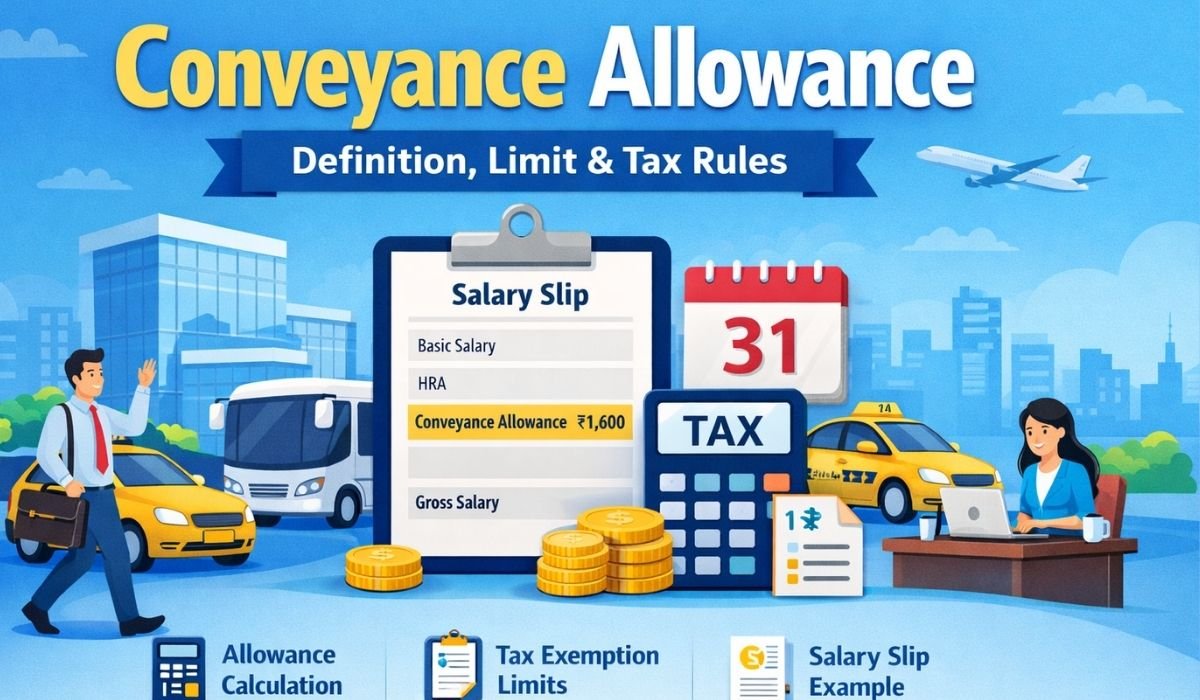
Conveyance Allowance is one of the most pervasive components in employee salary structure but not a lot of professionals know how it works. Salaried employee, HR and Business Owners are the ones having Planning purpose in salary optimizing will help you manage relatively better around taxes structure if you Read This article of Conveyance Allowance.
Here’s a comprehensive guide to everything you need to know about Conveyance Allowance – definition, limits of tax exemption, calculation method, eligibility criteria, difference with transport allowance, examples and latest rules along with its inclusion in the salary structure. This article is in simple English, so that you can easily understand the concept.
What is Conveyance Allowance ?
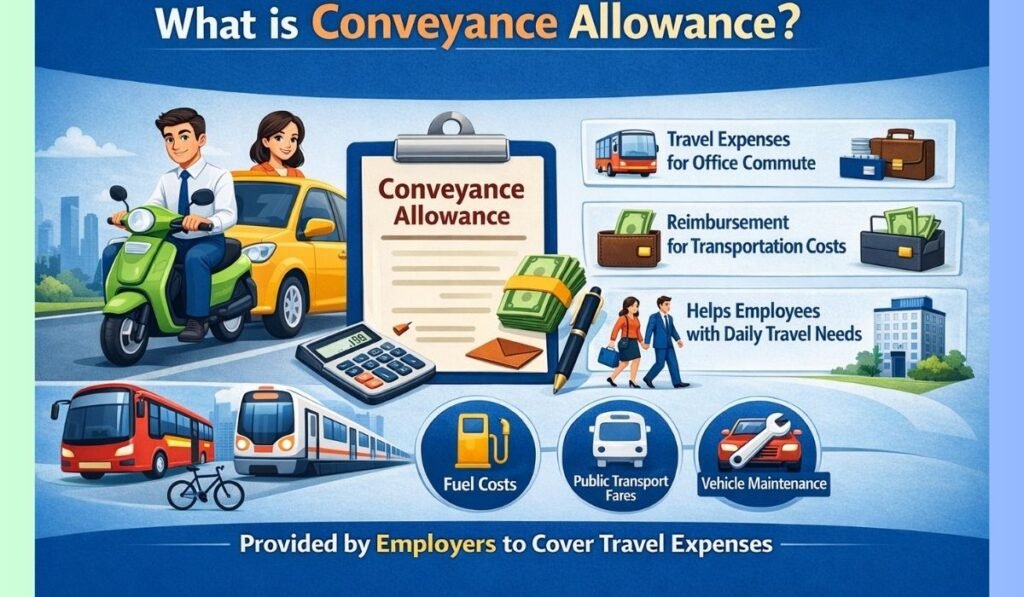
It is an expense reimbursement to cover travel expenses incurred by the employee when performing official duties. The amount given to you is meant to cover travel expenses for commutation like gas, cab rides or taking a bus etc.
Unlike reimbursement, Conveyance Allowance is generally paid as a fixed amount in the salary structure. Depending on the policy of the company, it may or may not involve submission of travel bills. The main purpose conveyed through the Conveyance Allowance is to lessen the financial embarrassment of employees who travel for office work.
In general, companies have a conveyance allowance in salary structures as it aids tax planning, offer better flexibility of salaries and help employees who travel frequently for work. It is mostly used in private companies, startups and corporate organizations.
Why Companies Provide Conveyance Allowance

Employers offer Conveyance Allowance salary components to provide relief and increase overall compensation structure. This helps employer and employee manage transportation costs and tax liabilities effectively.
Here are the most common reasons companies give this allowance:
- To reimburse employees for travel expenses incurred during official job-related activities, including meeting the clients, site visits and client meetings without having a major impact on take home salary.
- To optimize the salary in a tax-efficient way to ensure one part of the remuneration comes under Conveyance Allowance rather than being booked as fully taxable income.
- To reimburse Employees who travel frequently outside the office consequently incurring cost for fuel/taxi/local transport.
- To ease reimbursement process by offering a fixed sum rather than processing dozens of travel claims every month.
- To make salary packages attractive and competitive yet keeping company costs in check.
Conveyance Allowance Tax Exemption Limit
Tax exemption is one of the most essential parts of Conveyance Allowance. In earlier times, Income Tax rules had a fixed exemption on allowance however the same lay down as per structure of salary and tax regime.
Previously, employees were allowed to claim tax exemption for Conveyance Allowance up to a limit. Anything above that threshold is taxable income. Companies implementing this also helps the employees in calculating their taxable salary.
Standard Conveyance Allowance Exemption
| Category | Monthly Limit | Yearly Limit |
|---|---|---|
| Regular employees | ₹1,600 | ₹19,200 |
| Disabled employees | ₹3,200 | ₹38,400 |
For this reason, any salary exceeding the exemption cap becomes taxable as salary income if an employer pays more. To obtain exemption benefits, workers must also make sure the allowance is really spent for work-related travel.
How Conveyance Allowance is Calculated
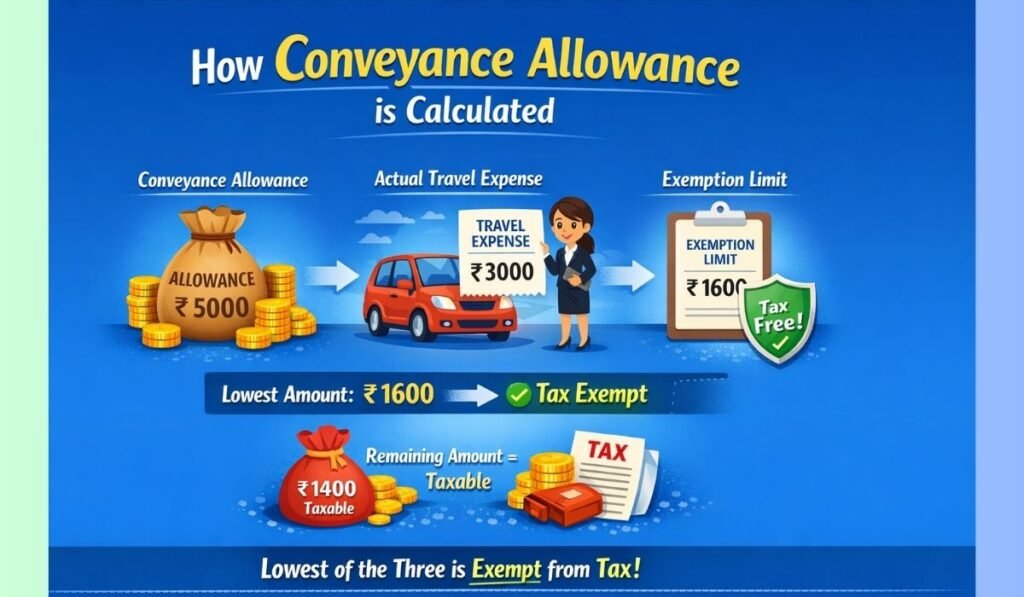
Conveyance Allowance is calculated based on 3 factors, namely the amount received, actual expenses incurred and exemption limit. Out of these values, the lowest one is eligible for tax exemption and the remainder is taxed.
So let’s get to know this with a simple Explanation. If an employee is credited a fixed Conveyance Allowance, but actual travel incurs lower expenses, then only the amount that allowable as per expense will not be taxable. If the expenses are less than allowance, unless full allowance becomes exempt.
Calculation Example
- Received Conveyance Allowance: ₹3,000 per month
- Real travel cost: ₹1,500 a month
- Maximum admissible exemption: ₹1,600 a month
Here, Exempt amount = ₹1,500
Taxable amount = ₹1,500
This calculation allows employees to only claim exemption on actual travel expenditure.
Who Can Claim Conveyance Allowance

Salaried employees who travel for official work are eligible for Conveyance Allowance. Not exclusive to one specific job function, but usually given to employees who travel as a part of their work.
Usually eligible employees for Conveyance Allowance:
- Nomadic sales workers who travel often to meet clients or conduct business development efforts off site.
- Field executives who travel to different places daily and are reimbursed for transportation used in official work.
- Supervisors and team leaders who have to attend meetings across branches or the client office.
- involves delivery workers or service staff who float between sites for day-to-day operational work.
- Employees in consulting, real estate, logistics and marketing jobs where travel is a regular function.
Conveyance Allowance vs Transport Allowance
Conveyance Allowance is often confused with transport allowance. Both are travel related, but serve different needs. Knowing the difference helps prevent confusion when segmenting salaries and filing taxes.
Transport allowance for travel to and fro from home and office. However, Conveyance Allowance is given for travel in relation to official work.
Key Differences
| Feature | Conveyance Allowance | Transport Allowance |
|---|---|---|
| Purpose | Official work travel | Home to office commute |
| Usage | Client visits, meetings | Daily commuting |
| Tax treatment | Limited exemption | Mostly taxable |
| Payment | Fixed salary component | Fixed or variable |
| Bills required | Sometimes | Usually not required |
Conveyance Allowance in Salary Structure
The Conveyance Allowance is a specialized entitling that appears separately in the salary break-up. It features under basic salary, HRA, special allowance and other parts.
For example, a basic salary structure with Conveyance Allowance is:
| Component | Amount |
|---|---|
| Basic Salary | ₹25,000 |
| HRA | ₹10,000 |
| Conveyance Allowance | ₹1,600 |
| Medical Allowance | ₹2,000 |
| Special Allowance | ₹6,400 |
| Gross Salary | ₹45,000 |
Instead, by shaping this system, companies can better divide their salary into other heads for tax planning and compensation flexibility.
Conveyance Allowance vs Travel Reimbursement
While Conveyance Allowance and travel reimbursement may be similar, they are different. The Conveyance Allowance is a monthly amount (fixed) and the reimbursement depends upon actual expenses with bills.
Here’s how they differ:
- Conveyance Allowance is paid as regular salary on a monthly basis without any adjustments being made to actual expenses incurred.
- You submit your travel bills, receipts or proof of expenses and only then do they pay you back.
- Conveyance Allowance is partly taxable (subject to limits) while Reimbursement is tax free.
- Salary, conveyance allowance has simple infrastructure depending on your character.
- Companies make a decision based on HR policy and operational requirements.
Benefits of Conveyance Allowance
The Conveyance Allowance has its own benefits for the employee as well as the employer. It increases salary flexibility and allows employees to save on transportation costs.
Some key benefits include:
- It is beneficial for employees to meet daily travel expenses related with official work without disrupting personal finances.
- It enhances salary structure behaviour by factored compensation.
- When there are exemption limits, it decreases the taxable income.
- It makes travel expenses easier to manage than reimbursement claims.
- It offers fixed predictable allowance to employees travelling periodically.
Disadvantages of Conveyance Allowance
That said, despite its usefulness, Conveyance Allowance comes with a few limitations as well. These should be understood by your employees before making heavy use of this component.
Some drawbacks include:
- Exemption limit on travel unrealistic due to standardization in a world of 100 million dollar bill.
- The excess over the exemption becomes taxable income.
- This allowance is withdrawn under the new tax regime slabs for certain companies.
- In some organizations, bills are needed for compliance.
And it might not be offered to all employees, subject to company policy.
Transport Allowance Under New Tax Regime
Many exemptions, including Conveyance Allowance may be unavailable under the new tax regime. However, salaried employees who opt for the new tax regime will generally not be able to claim exemptions individually.
Though companies still might have Conveyance Allowance in their salary structure. In those cases, the whole amount would be taxable income.
However, a comparison of both tax regimes need to be done by employees before choosing the regime.
When Conveyance Allowance Is Fully Taxed
In some cases, Conveyance Allowance is fully taxable. It’s important for employees to understand these so they don’t get confused when it comes time to file taxes.
Common situations include:
- When employee chooses for new tax regime in absence of exemptions
- When allowance exceeds exemption limit.
- If there is no official travel involved.
- If company places allowance in special allowance.
- When the documentation requirement is not met.
Illustration of Conveyance Allowance in Real Life
Let’s understand it with a real life scenario. Rahul is a sales executive and has Conveyance Allowance of ₹2,000 per month. He walks a little over 15 minutes to the nearest Mumbai Metro station – it costs him ₹20 each way, ₹50 if he has to use an Uber instead.
Only ₹1,400 is exempt in this case. Remaining ₹600 becomes taxable. This is a practical example of how Conveyance Allowance works and how employee need to calculate taxable portion.
The exemption will still be restricted to ₹1,600 even if Rahul spends ₹2,200 instead. This keeps tax benefits within allowable limits.
What HR Looks at While Deciding Conveyance Allowance
Conveyance Allowance varies by Companies depending on Role, frequency of travel, and Mindset Salary Structure. This component is then assigned by HR departments based on the operational needs.
Factors affecting amount include:
- Job role requiring frequent travel.
- City transportation cost.
- Company salary policy.
- Employee grade or level.
- Travel requirement frequency.
Documents Required for Conveyance Allowance
Some companies ask for documentation to justify the Conveyance Allowance exemption. Though not necessarily required, record-keeping is part of the process for tax assessments.
Common documents include:
- Travel log for official visits
- Fuel receipts
- Taxi invoices
- Client meeting records
- Travel approval emails
FAQs – Conveyance Allowance
What is Conveyance Allowance?
Conveyance Allowance – A part of Salary designated to compensate employees for travel-related expenditure incurred in the performance according to the duties associated with their employment. It reimburses work-related travel costs covering transportation expenses.
Is Conveyance Allowance taxable?
Conveyance Allowance is partially taxable. So, the amount which is beneath for exemption limit will be tax-free yet and this excess amount will become taxable income.
What is the limit of Conveyance Allowance?
The exemption limit is ₹1,600 per month for normal employees and ₹3,200 for disabled ones.
Who are entitled for Conveyance Allowance?
It applies to salaried employees who travel for work, including meetings with counterparties in the field or at a client site.
Is Conveyance Allowance same as travel allowance?
No, Conveyance Allowance is a fixed monthly payment, while travel allowance or reimbursement depends on actual expenses.
Conclusion
Conveyance Allowance is an important component of the salary structure, as it enables employees to manage transport expenses for work-related activities. Structured the right way, it’s also tax planning. By understanding how Conveyance Allowance works, employees can calculate taxable income correctly and maximise the salary benefits.
While a Conveyance Allowance is taxed on an Income Tax Rate basis, the exemption limits are small and still helps in reducing the burden by lowering travel costs. Companies utilize this piece to form adaptable compensation packages, whilst employees enjoy a defined salary allotment.
So, before you plan your salary or file your taxes, get yourself acquainted with eligibility, calculation method and tax rules related to Conveyance Allowance. Having the right knowledge can lead to better financial planning and prevent confusion between multiple terms.