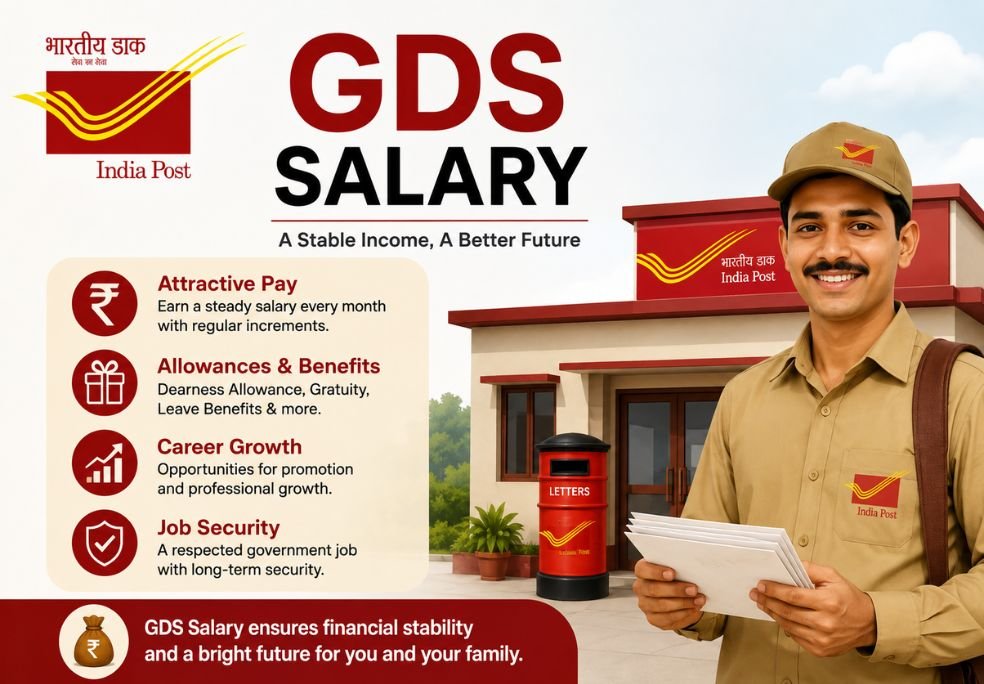
GDS Salary specifically focuses on the Gramin Dak Sevak position candidates will be joining in India Post. As many as 36,500 GDS are working in three categories such as Branch Postmaster (BPM), Assistant Branch Postmaster(ABPM) and Dak Sevak. While Central Government employees are governed by the normal pay matrix, GDS are governed under the Department of Posts, Gramin Dak Sevaks (Conduct and Engagement) Rules and hence get paid through Time Related Continuity Allowance or TRCA.
As per the latest January 2026 India Post GDS notification, the starting TRCA slab is ₹12,000–₹29,380 for BPM and ₹10,000-₹24,470 for ABPM/Dak Sevak. GDS also gets Dearness Allowance on TRCA and other entitlements.
This article discusses the GDS salary/month, structure of salary for GDS employees including allowances/deductions, growth in career prospects as a GDS employee, 8th Pay Commission to be implemented along with its long term earning potential.
What is the GDS Salary?
GDS Salary is the wages of Gramin Dak Sevaks are those working in the Department of Posts. The main part is Time Related Continuity Allowance (TRCA).
GDS employees are not regular Central Government employees. It is also explicit that the emoluments and service conditions in this regard shall not be at par with normal Central Government employees in India Post. GDS staff usually have to work for 4–5 hours a day and they are assigned in rural and non-rural postal stations according to their job.
The salary depends mainly on:
- GDS post or category
- TRCA slab
- Working hours and workload
- Dearness Allowance
- Applicable allowances
- Annual TRCA increase
- Other eligible benefits
The notice of January 2026 states that TRCA has a 3% annual increase, applicable under certain conditions.
GDS Salary Per Month
The monthly GDS salary is not simply a fixed amount because the total remuneration can include TRCA, Dearness Allowance and other applicable allowances.
As per the January 2026 recruitment notification, the basic TRCA slabs are:
| GDS Post | TRCA Slab (Approx.) |
| Branch Postmaster (BPM) | ₹12,000 – ₹14,500 Per month |
| Assistant Branch Postmaster (ABPM) | ₹10,000 to ₹24,470 Per month |
| Dak Sevak | ₹10,000 – ₹24,470 Per month |
So, hypothetically a GDS has a TRCA of ₹12,000 and they are given Dearness Allowance separately according to the existing rate as fixed by the Government. Hence it can have a higher credited amount to the worker than TRCA.
The operational monthly amount can be different, as allowances/deductions, workload-related components and any other payments due to work may vary.
Read More: LDC Salary Per Month || Loco Pilot Salary Per Month
India Post GDS Salary
TRCA Based Salary: India post GDS salary is paid according to TRCA instead of regular 7 CPC pay matrix. The most recent notification from the Traffic Registrar provides two main initial TRCA ranges more clearly.
The GDS Employees are entitled to the Dearness Allowance on TRCA also. India Post issued the notification in January 2026 stating, “The DA will be paid by the Government of India as and when notified.”
Regular Central Government employees are being given 60% of the basic pay/pension as DA with effect from 1 January 2026, increasing DA by 2 percentage points to posit a current level at 58%, which have been increased for posts above the choicepay scale (w.e.f. But the GDS remuneration should be seen separately as the GDS are not normal Central Government servants; their DA is regulated by the respective orders of GDS.
Hence, the regular employee pay-matrix calculation should not be blindly applied to GDS salary.
Post Office GDS Salary
The Post Office GDS Salary is the salary paid to those personnel working in any of the departments in the Postal Network. Mail Delivery, Sale of Stamps and stationery, conduct customer transactions on IPPB work and other duties assigned by Postmaster.
Example → For instance, the Dak Sevak posts may include departmental offices, the Sub Post Offices (SPO), the Head Postal Office (HPO) and Railway Mail Service preʻiḍians.
The total remuneration for a GDS employee usually includes:
- TRCA
- Dearness Allowance
- Eligible allowances
- Applicable incentives or other payments
- Social-security-related benefits
It varies depending on the post, TRCA slab and department policies.
GDS Salary in Post Office
GDS Salary in Post Office varies mainly according to whether the candidate is appointed as a BPM or ABPM/Dak Sevak.
| Position | Initial TRCA Range | Main Responsibility |
| BPM | ₹12,000–₹29,380 | Managing Branch Post Office and postal operations |
| ABPM | ₹10,000–₹24,470 | Supporting BPM and handling postal/customer services |
| Dak Sevak | ₹10,000–₹24,470 | Mail delivery, transactions and other assigned duties |
The BPM position carries the higher initial TRCA slab. BPM candidates also have an important additional responsibility: according to India Post, they are required to arrange accommodation for operating the Branch Post Office at their own cost.
GDS Salary Structure 2026 – Detailed Breakdown
The GDS salary structure in 2026 can be understood through the following components:
| Salary Component | Description |
| TRCA | Main remuneration component |
| Dearness Allowance | Paid on TRCA according to applicable government orders |
| Annual Increase | 3% annual increase in TRCA, subject to conditions |
| Other Allowances | Applicable allowances depending on duties and rules |
| Social Security | GDS Gratuity and Service Discharge Benefit Scheme |
| Deductions | Applicable statutory/departmental recoveries |
The latest January 2026 notification specifically confirms the 3% annual TRCA increase and entitlement to DA, GDS Gratuity and Service Discharge Benefit Scheme.
GDS Salary – Key Components
TRCA:
This is the foundation of GDS remuneration.
Dearness Allowance:
DA is paid on TRCA and is revised according to applicable government orders.
Annual Increase:
TRCA has a 3% annual increase subject to the prescribed conditions.
Other Allowances:
Depending on the nature of work and eligibility, a GDS may receive applicable allowances such as conveyance/delivery-related allowances or other departmental payments.
Social Security Benefits:
The GDS package includes benefits such as GDS Gratuity and the Service Discharge Benefit Scheme.
State-Wise GDS Salary
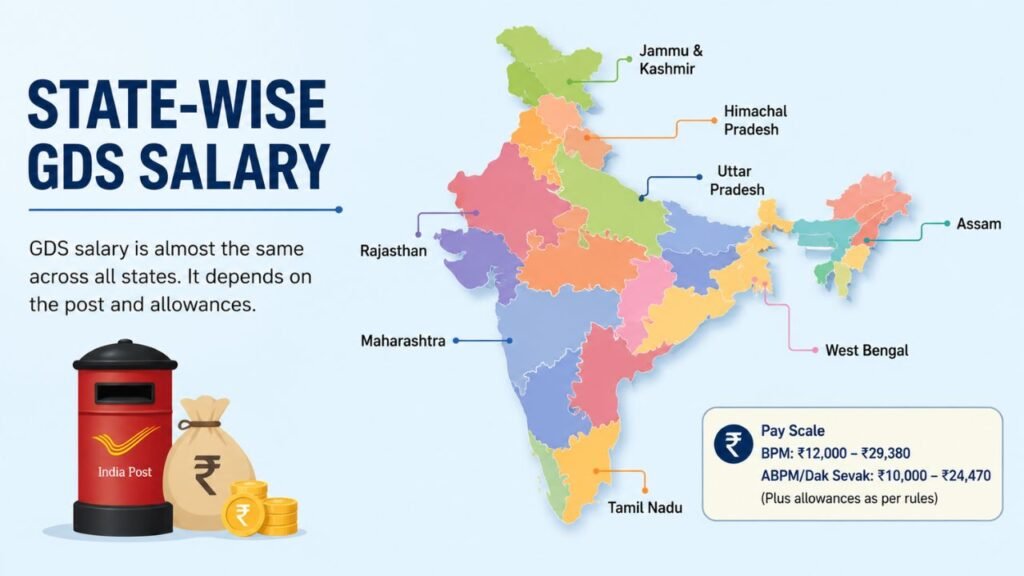
In general, no separate basic TRCA slab exists for each state. GDS TRCA slabs are national level slabs, which are prescribed by the Department of Posts.
The recruitment circle, numbers of vacancies, regional language requirement, nature of work place and eligibility for certain allowances can be state specific.
The recruitment for January 2026, was conducted district-wise, with postings and shortlisted names announced across different postal circles, e.g.
He advised that candidates should be cautious with the websites stating that one state altogether has a different basic GDS salary slab than another without an official departmental order presiding over it.
Read More: State-Wise Up Police Constable Salary || State-Wise SSC MTS Salary
Allowances That Boost the GDS Salary
In addition to TRCA and DA, other payments may be made to eligible GDS employees based on the work assigned by them in accordance with rules applicable.
Possible components may include:
- Delivery or conveyance-related allowance
- Office maintenance-related allowance
- Combined duty allowance
- Special duty allowance
- Travelling allowance where applicable
- Incentives under applicable schemes
- Other departmental allowances
India Post’s accounting document contains a number of GDS related payment heads like delivery and conveyance allowance, office maintenance allowance, combined duty allowance,special duty allowance,incentives and service discharge benefits.
They do not pay every GDS employee for the allowances. Eligibility depends on the post, department, service and place.
Deductions from GDS Salary
A GDS’s gross remuneration may not necessarily be the amount they end up with. Relevant deductions comprise contributions or recoveries under department plans and other accepted deductions.
One of the important components is the Service Discharge Benefit Scheme (SDBS). SDBS, according to the Department of Posts, is a benefit for GDS personnel part of the social-security scheme.
Other deductions could be based on the individual GDS circumstances i.e.
- SDBS-related contribution where applicable
- Income-tax/TDS, where applicable
- Recovery of advances
- Authorized departmental recoveries
- Other legally permitted deductions
It is why candidates need to make sure there is a difference between gross GDS salary and real take-home.
GDS Salary During Training Period
Department Guidelines: GDS candidates have to go through the mandatory training and induction process before or at the beginning of their assigned job role.
One should not expect the quantum of salary/remuneration during training to be that for a regular Central Government servant while under training. GDS are employed according to their own regulations and circumstances.
For this reason the remuneration (including training period allowance) and joining conditions should be verified with appointment order along with existing Department of Posts instructions.
GDS Salary After Promotion – Career Growth
With regard to recruitment in the higher ranks of postal departments there are opportunities for promotion based on departmental vacancy and eligibility through competitive exams.
Some of the opportunities that you can have when building your career include:
- Postman
- Mail Guard
- Multi-Tasking Staff
- Other departmental posts depending on the relevant recruitment regulations
GDS candidates have routes for competing against some in the Departmental posts via India Post Rules on recruitment. Example: With the introduction of certain alternative methods, like through GDS for Postman/Mail Guard so far to select by Competitive exam path.
GDS Salary After Promotion (7th Pay Commission)
This is an important distinction.
Also Read: GDS has a normal 7th CPC pay-matrix also. TRCA is the basis for GDS remuneration.
For example, If a GDS successfully enters in regular departmental post through valid recruitment and promotion route, the pay of that new post may be regulated under regular Central Government pay structure applicable to that new Post.
So it is incorrect to say that all GDS gets 7th CPC pay-matrix salary of post after a certain number of years.
GDS Salary After 5 Years
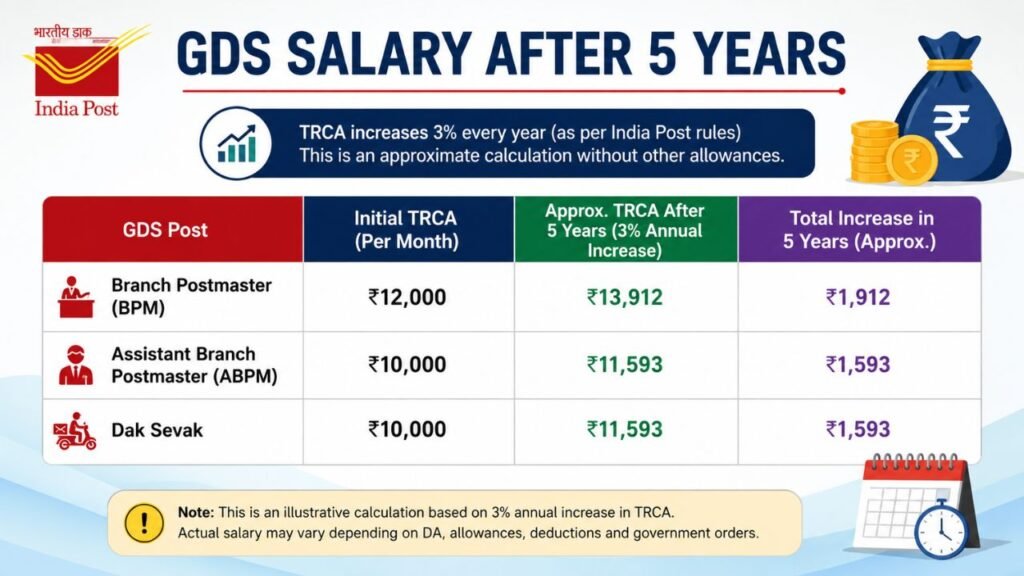
There is no single fixed “GDS salary after 5 years” because the TRCA increase is subject to the applicable rules and conditions.
The January 2026 notification confirms a 3% annual increase in TRCA.
If we use a simple illustrative calculation of 3% annual growth without considering changes in rules, promotions or other adjustments:
| GDS Post | Initial TRCA | Approx. TRCA after 5 annual increases* | Approx. after 5 Year increases* |
| BPM | ₹12,000 | ₹13,912 | ₹1,912 |
| ABPM | ₹10,000 | ₹11,593 | ₹1,593 |
| Dak Sevak | 10,000 | ₹11,593 | ₹1,593 |
*Illustration only. Actual fixation depends on departmental rules and eligibility.
DA and other eligible allowances would be separate from this amount.
GDS Salary After 10 Years
Similarly, the GDS salary after 10 years cannot be stated as one guaranteed figure.
Using only a mathematical illustration of a 3% annual increase:
| Initial TRCA | Approx. TRCA after 10 annual increases* |
| ₹10,000 | ₹13,439 |
| ₹12,000 | ₹16,126 |
*These are illustrative calculations and are not an official salary forecast. Actual TRCA progression may depend on departmental rules, revisions and service conditions.
Promotion into a regular postal post can also significantly change the salary structure.
GDS Salary vs Other Government Jobs
GDS is often compared with MTS, Postman, Police Constable and other government positions. However, direct comparison can be misleading because GDS is a distinct engagement category.
India Post explicitly states that GDS personnel are not regular Central Government employees and their emoluments and entitlements are not at par with regular employees.
Non-Monetary Benefits of the GDS Salary Package
The value of GDS for employment is not just limited to monthly salary.
Depending on the applicable rules, benefits can be:
- GDS Gratuity
- Service Discharge Benefit Scheme
- Limited transfer provisions
- Leave-related benefits
- Certain welfare and social-security benefits
- Experience in India Post
- Departmental opportunities to play for positions
India Post has earlier elaborated the advantages like GDS Gratuity, SDBS, maternity leave benefits, emergency leave and limited transfer facilities under the GDS regime. Hence, the current things must be verified with amended rules and orders of the department.
How to Maximize Your GDS Salary
Candidates and serving GDS employees can focus on several areas to improve their long-term earning potential.
1. Understand Your TRCA
Know your current TRCA slab and ensure that applicable annual increases are correctly reflected.
2. Check Eligible Allowances
If your role involves duties that qualify for specific allowances, understand the relevant departmental provisions.
3. Build Departmental Career Opportunities
GDS employees interested in higher earnings should monitor departmental recruitment and competitive examination opportunities.
4. Maintain Accurate Service Records
Keep appointment, service, training and benefit-related documents properly maintained.
5. Follow Official India Post Updates
Salary and allowance rules can change through departmental orders. Candidates should rely on official India Post notifications rather than social-media salary charts.
Read More: Software Engineer Salary || Merchant Navy Salary
FAQs About GDS Salary
1. What is the starting GDS salary in 2026?
According to the January 2026 India Post notification, the initial TRCA is ₹12,000–₹29,380 for BPM and ₹10,000–₹24,470 for ABPM/Dak Sevak. DA and applicable allowances are additional.
2. Is GDS a permanent government job?
GDS personnel hold civil posts but are not regular Central Government employees. Their service conditions are governed by the GDS Rules.
3. Do GDS employees get Dearness Allowance?
Yes. The official January 2026 notification states that GDS personnel are entitled to Dearness Allowance on TRCA as declared by the Government from time to time.
4. What is the BPM salary in GDS?
The initial BPM TRCA slab is ₹12,000–₹29,380. The final monthly remuneration can be higher after applicable DA and allowances.
5. What is the ABPM salary in GDS?
The initial ABPM TRCA slab is ₹10,000–₹24,470, plus applicable DA and other eligible payments.
6. Does GDS salary increase every year?
The official 2026 notification states that TRCA carries an annual increase of 3%, subject to fulfilment of applicable conditions.
7. Will the 8th Pay Commission increase GDS salary?
There is currently no confirmed GDS salary revision under the 8th Pay Commission. The Commission is still working and has not announced a final GDS-specific salary structure.
Conclusion
GDS Salary 2026 follows the Time Related Continuity Allowance system instead of the standard Central Government pay matrix. As per the most recent January 2026 India Post notification, BPMs have a starting TRCA slab of ₹12,000-29,380 while ABPMs and Dak Sevaks are given a slab of ₹10,000–24,470. GDS employees can also receive Dearness Allowance as applicable; a 3% annual TRCA hike subject to conditions and many social security benefits.
Candidates must keep in mind that GDS is not a regular Central Government job to plan long-term careers. The largest potential salary increases will derive from TRCA annual progression, eligible allowances and career opportunities within the department.
Currently, the 8th Pay Commission is in progress but a Final GDS-specific salary revision hasn’t been officially announced until August 2026. Hence, candidates are advised to not fall back into the speculated salary ranges that had been in circulation and look for official notices of changes from the Department of Posts in the future.
Candidates are advised to keep checking the official India Post GDS recruitment portal and the official 8th Central Pay Commission website for the most authentic updates.

Dalvi is a passionate content writer and digital researcher associated with SalarySlip.co.uk, specializing in finance, salary insights, and career guidance. With a strong focus on delivering accurate and user-friendly information, Dalvi creates well-researched content that helps readers understand payslips, tax structures, and income-related topics. Backed by a keen interest in SEO and digital trends, Dalvi ensures every article is informative, engaging, and optimized for search engines, making complex financial concepts simple and accessible for everyone.